John E. Smith: A PIONEER OF THE SPOKANE COUNTRY
The Washington Historical Quarterly, Vol. VII., No. 4, October, 1916
This relation was made by John E. Smith of Reardon, Washington, to William S. Lewis, Corresponding Secretary of the Spokane Historical Society. The text is given in the words of Mr. Smith and signed with his name. The footnotes are by Mr. Lewis, to whom the Quarterly is indebted for the article. Editor.
Additional notes by Brian Hildebrand, 3rd great grandson of John E. Smith
I was born at Newark, New Jersey, on June 8th, 1835. My parents were both Scotch; my mother was Margaret Easton; my father, John Smith. As a small boy I was often on the boats about Newark and Passaic, New Jersey.
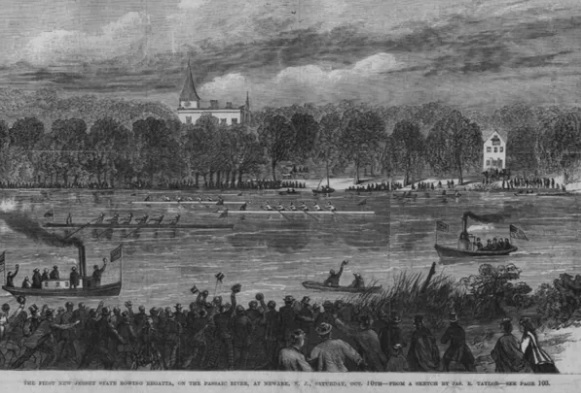
In John Smith’s youth steamship technology was rapidly transforming the navigation of oceans and rivers alike. Regular freight runs were made between Newark and New York City, and the Morris Canal brought coal from western New Jersey to Newark, allowing for the rapid growth of industrialization.

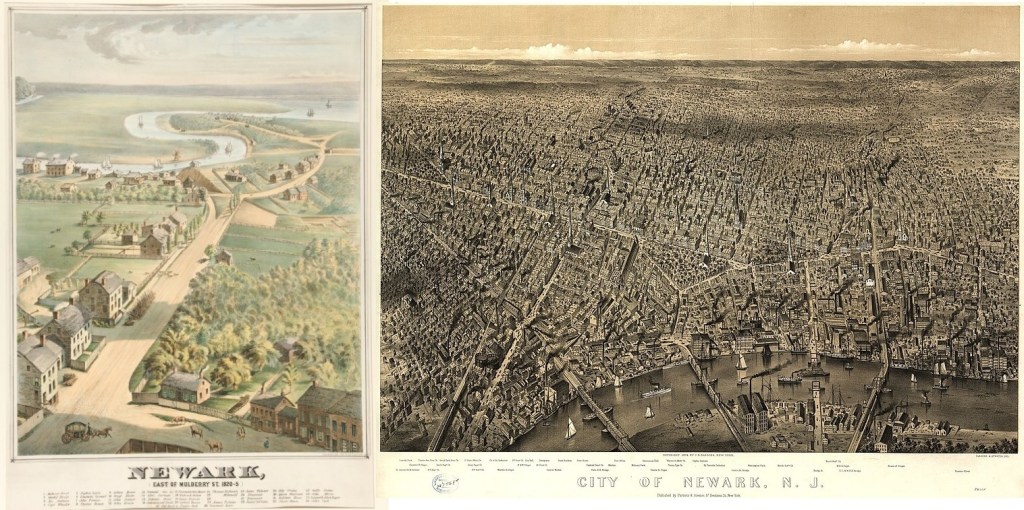
By the time Newark achieved city status in 1836 it was one of the industrial hubs of the nation. Unfortunately there don’t seem to be any images online that cover the era of Smith’s childhood, but the explosion of the city can be seen in the 50 years between 1825 and 1874.
John E. Smith:
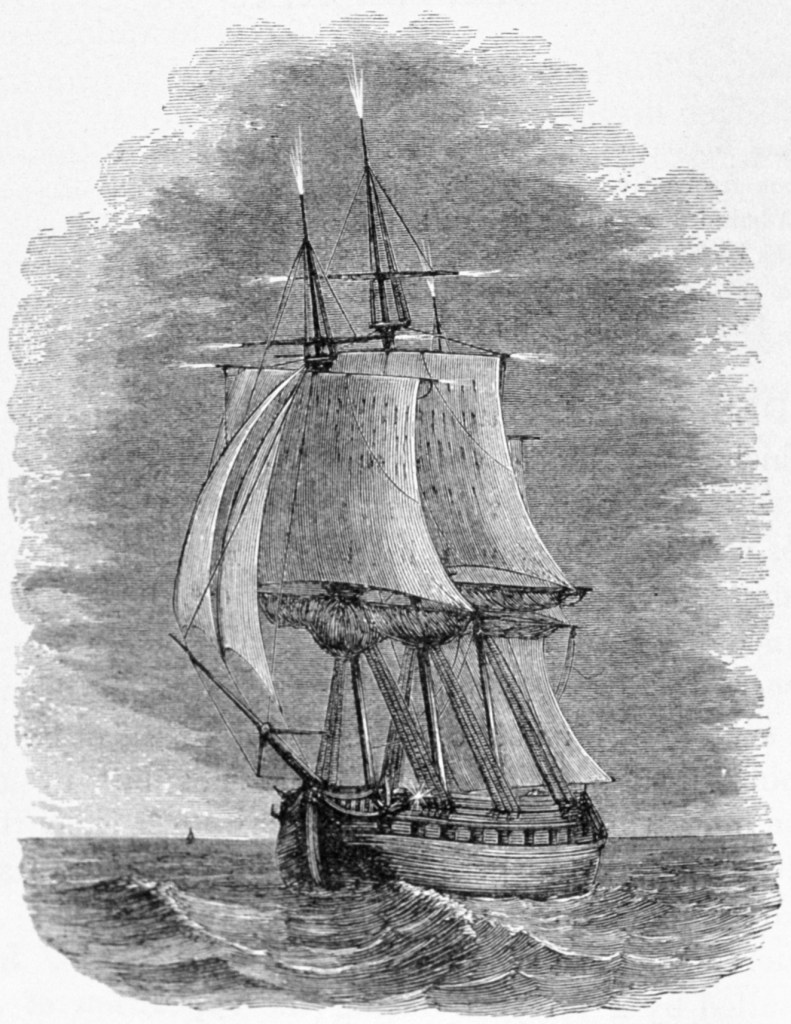
In 1849, when I was a lad of fourteen years, I sailed from New York for California as cabin boy on the Mary and Adeline, a government transport that brought out some troops to California. If I recall correctly, these were two companies of the 2nd Infantry. We went around the Horn. This was my first experience at sea.
The sailing of this ship is confirmed in a military report by Christopher S. Lovell:
“At the close of the Mexican War, when the volunteer troops were mustered out of service, California was left with only one company of Third Artillery and one of First Dragoons, both badly depleted by the desertion of men attracted to the gold diggings.”
“The entire Second Infantry Regiment was ordered to California, coming by sea via Cape Horn. All but two of the companies reached San Francisco in April and May. Companies A and E, aboard the transport Mary and Adeline, did not arrive until the end of June.”
The voyage around Cape Horn was a common, though long and often arduous, sea route from the East Coast to California before the Panama Canal was built. It typically took four to eight months for sailing ships to complete the 17,000-mile journey, with the Mary and Adeline’s taking over 6.
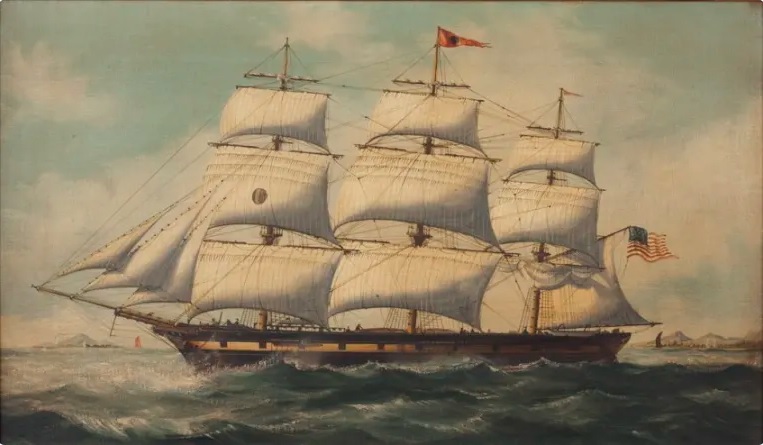
As a military transport, the Mary and Adeline was likely a packet ship rather than a sleek clipper ship, optimized for capacity and durability over speed. Making the journey in early 1849 they would have faced violent gale-force winds and massive waves up to 80 feet high.
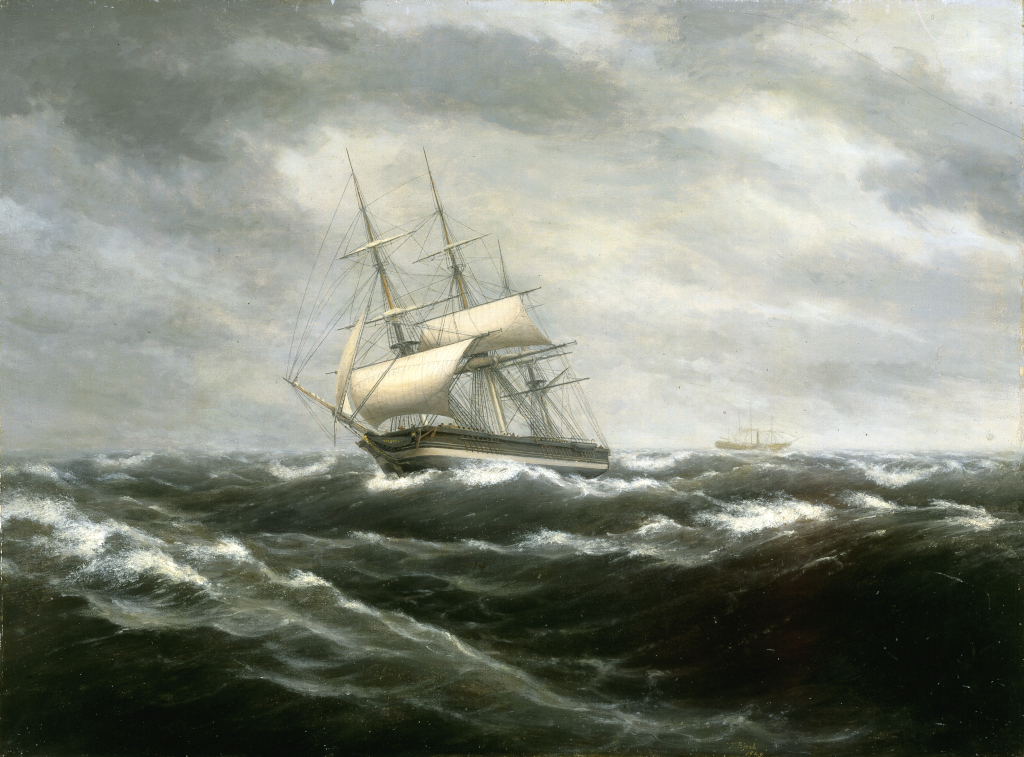
On the flip side, they also could have been caught in the equatorial region known as the “Doldrums” for an extended period, delaying their arrival compared to the other two ships that left at the same time. Sometimes the speed of such voyages just came down to lucky timing.
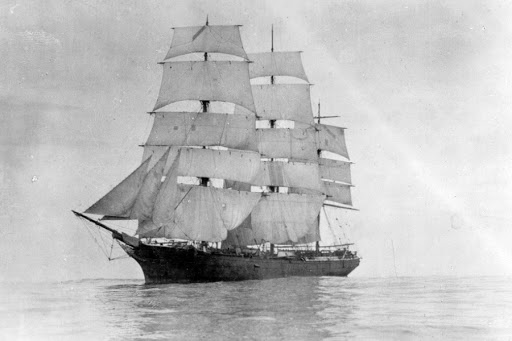
As a cabin boy at age fourteen on a mid-19th century government transport ship, roles and duties would have been varied, often involving menial work, but also serving as an apprenticeship in seamanship.
The primary role of a cabin boy was to wait on the ship’s officers (and any military officers/passengers), running errands and messages for the officers and ensuring their quarters were tidy.
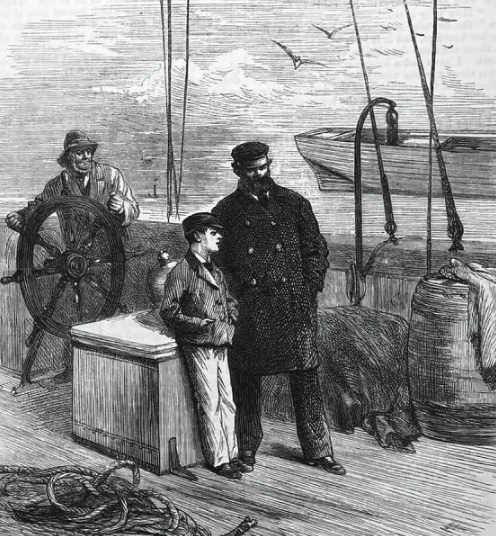
General cleaning tasks were common, including swabbing decks, and potentially less pleasant chores like cleaning the livestock pens, if the ship carried live animals for fresh meat. The ship’s boy also helped in the galley, which could involve preparing food or carrying buckets of food from the kitchen to where the rest of the crew ate.

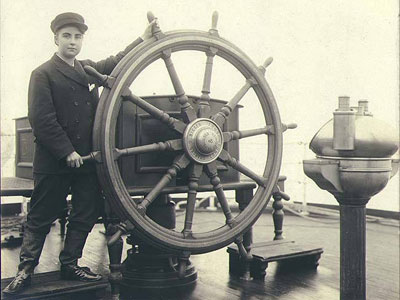
As an apprentice you would learn basic sailing skills, such as knot-tying and the names and functions of the rigging, and go aloft in the rigging to assist with trimming sails and other tasks. If the weather was nice enough you might even take the wheel for a bit and help keep the ship on course.
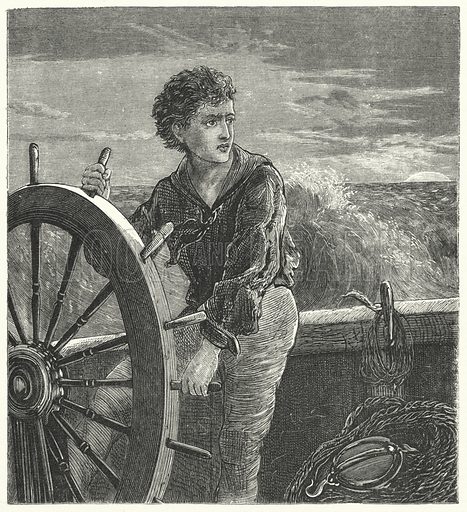
Although it is from the perspective of a 34 year-old passenger rather than a 14 year old cabin boy, Notes of a Voyage to California via the Horn by Samuel C. Upham gives us the best idea of what that voyage was like in 1849:
Monday, January 15, 1849.
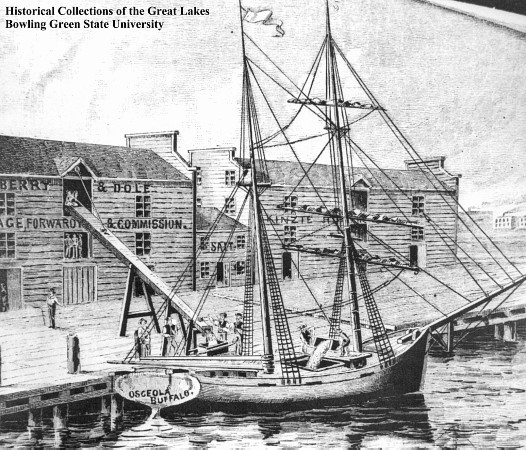
Carried my baggage on board the brig Osceola, Captain James Fairfowl, bound from Philadelphia to San Francisco, California. At eleven o’clock, P.M…. went on board the brig to spend the night, expecting to sail early the next morning. The weather being cold, and no fire in cabin or steerage, I slept very little during the night. Two brothers of the name of Kelly, companions en voyage, accompanied me on board.
Tuesday, Jan. 16.
At eight o’clock, A.M., the City Ice-boat made fast to the Osceola, and we were soon passing slowly down the Delaware. In consequence of the early hour at which we got under way, not more than one-half of our passengers were on board when the Ice-boat made fast to us.
We had not, however, gotten fairly into the stream, before the belated passengers might be seen at different points along the wharves, swinging their hats and 24 caps, and yelling at the highest pitch of their voices for the Osceola to slacken her speed and take them on board.
One of the passengers, a corpulent individual, whom I shall designate as the Doctor, went shouting along the wharves until his safety-valve collapsed, and his steam and gas having become exhausted, he availed himself of the facilities offered by a boatman and came on board wheezing like a person afflicted with the asthma.
Passengers came off to the brig at different points along the Delaware between Race Street and the Navy Yard, and at the latter place the last straggler arrived.
Friday, Jan. 19.
…Of the sixty-five passengers, all are sea-sick with the exception of three. The lee-rail is completely lined with demoralized passengers, who are paying their tribute to old Neptune. Those who are not able to pay their respects to the deity of the great deep over the rail, are casting up their accounts in buckets, wash-basins and spittoons. In consequence of the coldness of the weather, I remained in my berth all day.
Considerable excitement was caused to-day in consequence of the man at the wheel being found slightly inebriated. This led to an investigation of the matter, and in searching the forecastle a jug of whisky was found in the chest of one of the sailors, which the Captain ordered thrown overboard. Distance sailed, 184 miles.
Saturday, Jan. 20.
… Sea-sick passengers look better this morning. Those that are able to crawl out of their berths are on the poop-deck taking the benefit of a little sunshine…. Several squalls during the afternoon, accompanied by hail. Distance sailed, 109 miles.
Sunday, Jan. 21.
…brig laboring and straining very much, and shipping heavy seas. Owing to the rough weather, the passengers are nearly all sea-sick again. No cooking and but little eating done today in consequence of the galley having been unshipped by a heavy sea. Distance sailed, 128 miles.
Monday, Jan. 22.
…Cook’s galley fitted up today; started a fire, and the cook commenced operations in the culinary line. The steerage passengers complain bitterly of a scanty allowance of food, also of the manner in which it is cooked. A small codfish and two dozen potatoes were served up today for dinner for thirty-six steerage passengers. This circumstance being reported to the Captain, he promises that all shall be right on this score hereafter. Distance sailed, 116 miles.
Tuesday, Jan. 23.
…Have had several light showers during the day, but the atmosphere is delightful. The passengers have nearly all recovered from their sea-sickness, and are lounging about the decks amusing themselves in various ways. They have not yet gotten their sea-legs on, consequently, cannot walk about the decks very readily… Distance sailed, 176 miles.
Wednesday, Jan. 24.
…Several of the steerage passengers have spread their mattresses and blankets on deck for the purpose of drying them in the sun. Owing to the leaky condition of the deck, the upper tier of steerage berths have been saturated with water since leaving Philadelphia.
The Captain and second mate had an altercation this morning, in which they called each other everything but gentlemen. This war of words ended by the Captain sending the mate below and putting him off duty… Distance sailed, 157 miles.
Thursday, Jan. 25.
…The steerage passengers still complain of their accommodations. They have been grossly imposed upon by Burling & Dixon, owners of the brig. A large portion of the steerage is occupied with freight and luggage belonging to the cabin passengers. Bills of lading having been executed for the freight it should have been stored in the hold of the brig or left on shore.
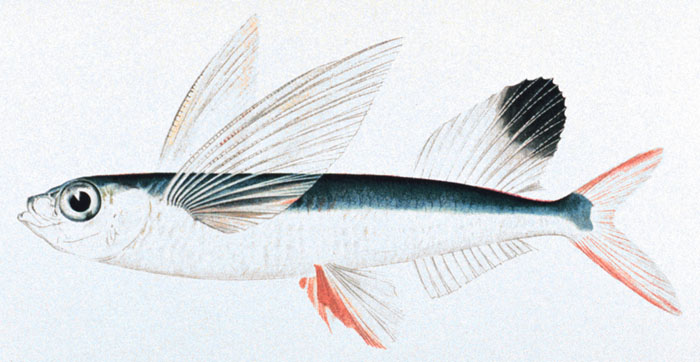
A flying-fish was found on deck this morning, it having flown on board during the night. It was cooked and eaten by one of the passengers. Distance sailed, 143 miles.
Friday, Jan. 26.
…The jib was split today during a severe squall. The steerage passengers assisted the crew in shortening sail.

The Osceola left Philadelphia without a full crew, having only six men and two boys before the mast to work a brig of two hundred and seventy-six tons burthen, around Cape Horn. Distance sailed, 140 miles.
Saturday, Jan. 27.
Gale still continues with increased violence. Top-sails double-reefed; sea running very high and brig straining badly.
Topsails are the second sails up. To reef a sail is to draw part of it up to the yard to reduce the area of sail exposed to the wind. Topsails have three and sometimes four reef-bands running across the upper half, where there are short lengths of rope that can be used to tie the sail to the rope or cable along the bottom of a yard. To double-reef them is to haul them up as far as the second reef-band.

In the afternoon, the crew commenced shifting deckload, which was somewhat wet and damaged. Found that the water in one cask had entirely leaked out, and another cask was only one-third full.
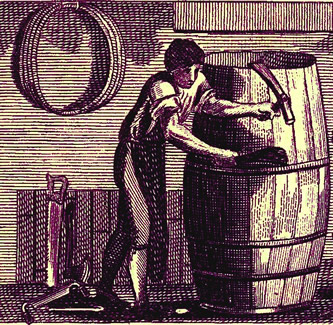
Burling & Dixon, in their hurry to get the brig to sea, caused the water-casks to be filled without having the hoops tightened, hence the result. If the casks in the hold are in the same condition as those on deck, we shall most certainly be on a short allowance of water in the tropics. Distance sailed, 72 miles.
Sunday, Jan. 28. …Distance sailed, 31 miles.
Monday, Jan. 29.
At daylight this morning the wind suddenly increased to a gale. We were compelled to hard-up the helm in order to get the canvas off the brig. At eight o’clock, A.M., hove to under close-reefed maintop-sail and stay-sail, with a heavy sea running, which caused the brig to strain very much.
To add to our peril, the forward cabin now began to work with the strain of the deck-load. The safety of the brig compelled the Captain to give orders to heave overboard the principal part of the deck-load to ease her. With the exception of a few ship’s stores, it belonged to the passengers, and consisted of provisions, brandy, house-frames and gold-washers.
Unfortunately, several of the passengers had their entire freight on deck, consisting of provisions for their subsistence in California. Poor fellows! they will be in a sad plight on arriving in San Francisco, almost penniless and without provisions. The throwing overboard a cargo at sea for the purpose of saving the ship is anything but agreeable when nothing but a plank separates one from eternity.
During the gale the following ludicrous incident occurred: While all hands, passengers and crew, were busily engaged staving in the heads and throwing overboard brandy, molasses and vinegar casks, a fellow-passenger, who had “Done the State some service” during the late war with Mexico, and being withal a great lover of whisky, caught up from off the deck both hands full of a mixture of brandy, molasses, vinegar and salt water, and after taking a hearty swig, exclaimed, “ Jimminy, boys, this is first-rate swankey.”
The same individual, during the destruction of the brandy casks, labored extremely hard to preserve one from the general wreck, which on being broached, proved to be, to his great chagrin, a brandy cask filled with pilot-bread. While the casks composing the deck-load were waltzing to one of the tunes of old Boreas (Greek god of the wind – ed.), the two ship’s boys and one of the passengers had their propellers (steamship-era slang for legs? – ed.) slightly injured. Distance sailed, 116 miles.
Tuesday, Jan. 30.
Went on deck at six o’clock this morning and found the gale still raging; brig under close-reefed sails. The main-hatch was broken out to-day for the purpose of getting at the water, all on deck having been used. In consequence of the leaky condition of the casks, one-third of the water was found to have leaked out of each of the five casks broken out. We shall most certainly suffer for the want of fresh water before reaching Rio de Janeiro… Distance sailed, 124 miles.
Wednesday, Jan. 31.
Went on deck this morning at seven o’clock and found the brig jumping through the water at the rate of eight knots an hour, with starboard studding-sails all set. This is the most delightful day experienced since leaving Philadelphia. We had a partial break-out in the steerage today, which has added very much to the convenience of the passengers. The Captain ordered the boody-hatch removed for the purpose of more thoroughly ventilating the steerage. The brig has no wind-sails* on board, but the Captain has promised to have one made for the steerage at once. Distance sailed, 49 miles.
* “wind sail: a sail rigged over a hatchway, ventilator, or the like, to divert moving air downward into the vessel.”
Thursday, Feb. 1.
…This being duff-day, the flour and raisins were served out last evening to the caterers of the steerage messes for their duff. The ingredients were accordingly mixed and taken to the cook last evening in order that they might be put into the coppers early this morning to boil for dinner; but the boys, on going to the galley for their coffee, were taken all aback by the cook’s presenting them with their duff for breakfast, piping hot, a mistake chargeable to the misplaced zeal of the son of a sea-cook! The circumstance was reported to the Captain, who gave the cook orders in future not to boil duff* for breakfast! Distance sailed, 158 miles.
* “duff: a boiled or steamed pudding often containing dried fruit.”
Friday, Feb. 2.
…At eleven o’clock last night the wind commenced blowing a gale from N.N.E. At twelve o’clock split foretop-sail; soon after sent down royal-yards and hove the brig to. At eight o’clock this morning repaired top-sail and let the close reef out of the maintop-sail. At meridian, the storm abated somewhat, but the sea is still running very high, causing the brig to labor heavily and ship an occasional sea.
Commenced reading to-day a work entitled “WHAT I SAW IN CALIFORNIA,” by Edwin Bryant, in which I am deeply interested. Mr. Bryant traveled the overland route to California, via Independence, Missouri; and I regret very much that I did not take the same route in preference to this, via Cape Horn. Descriptions of a “life on the ocean wave” read very prettily on shore, but the reality of a sea voyage speedily dispels the romance. Distance sailed, 84 miles.
Saturday, Feb. 3.
…God grant that we may have a safe and speedy passage to our port of destination, and that, on our arrival, our most sanguine expectations may be realized. Distance sailed, 166 miles.
Sunday, Feb. 4.
…I regret exceedingly that I did not bring a Bible and Prayer-Book with me, for I expect to do my own preaching during the next two years. California will probably be better supplied with mosquitoes than ministers. Distance sailed, 125 miles.
Monday, Feb. 5.
…Passengers assisted the crew in breaking out the main-hold for water and provisions. Found the water in two of the casks nearly half leaked out, which fully confirms in my mind a previously-expressed opinion that we shall run short of fresh water before reaching Rio de Janeiro.
Several of the passengers have already become weary of a sea voyage, and have been talking very strongly to-day of leaving the Osceola at Rio, crossing the Andes to Valparaiso, and awaiting there the arrival of the brig, thus avoiding the passage around Cape Horn… Having paid my passage to San Francisco on board the brig Osceola, I intend, if my life be spared, to remain by her until she reaches that port or goes to Davy Jones’s locker. Distance sailed, 92 miles.
Tuesday, Feb. 6.
…The brig is making nine knots an hour, which is something remarkable for her, and all hands, including the cook, feel jolly….
The crew, assisted by the passengers, broke out the main-hold again to-day in search of water. More leaky casks found, in consequence of which the Captain has put all hands on an allowance of five pints of water to each person. Yesterday, we struck the “trades,” in longitude 37° 20′. Distance sailed, 182 miles.
Trades refers to the Trade Winds, with trade meaning “path” rather than “exchange”. They could be counted on to blow steadily westward from around 30 degrees north to 30 degrees south, driven by the convergence zone of the equator and the rotation of the earth. The video below explains it well, although it mis-lables 30 degrees south as north…
Wednesday, Feb. 7.
…The cabin passengers have been growling for some time about their miserable accommodations, and today have declared war to the knife.
They have resolved to hold an indignation meeting, and on their arrival at Rio de Janeiro to report the proceedings with their grievances to the American consul at that port, and ask his interference in the matter. they swear by all the saints in the calendar that the Osceola shall not leave Rio until matters are adjusted to their entire satisfaction.
Both cabin and steerage passengers have much cause for complaint, and I sincerely hope that justice may be done to all on board before the Osceola leaves Rio. Distance sailed, 190 miles.
Thursday, Feb. 8.
We crossed the Tropic of Cancer today and may expect excessively hot weather until we cross Capricorn.
Last evening an altercation occurred between the Captain and first mate, Mr. Howell, in relation to the pumps, which resulted in the latter being put off duty. During the controversy they were not very choice in their selections from the King’s English.
The opinions of the passengers, in relation to this matter, appear to be about equally divided, although I am inclined to the belief that were a vote of all on board registered, a majority would be found in favor of the mate… Distance sailed, 176 miles.
Friday, Feb. 9.
The weather this morning is as clear and balmy as a May morning in Philadelphia, and the brig is gliding along at the rate of eight knots an hour.
In consequence of the first mate being off duty, the first watch last night was kept by one of the passengers, who in early life had served on board a man-of-war. There is nothing, in my opinion, more essential to the safety of a vessel and the lives of her passengers than harmony among her officers. The Captain and mates of the Osceola have been at loggerheads since leaving Philadelphia, and God only knows how much longer this asperity of feeling will continue to exist between them.
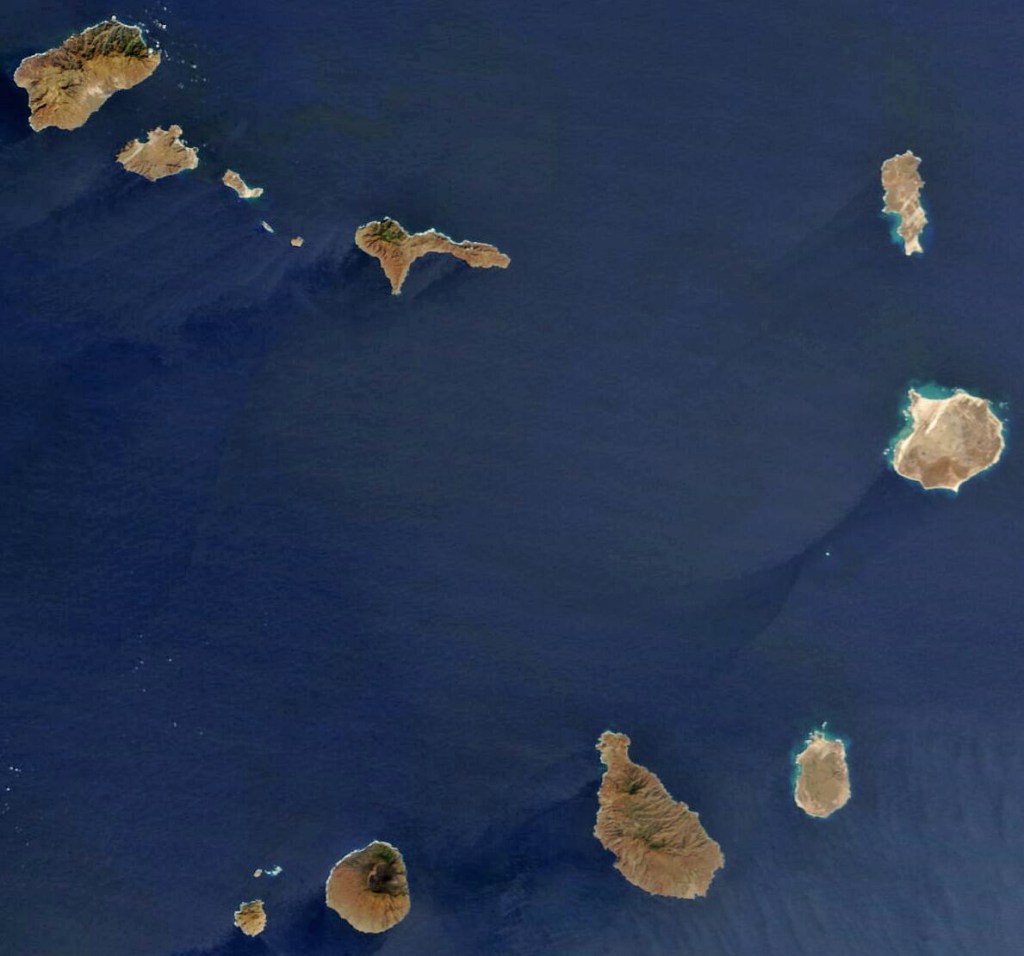
We are today in the latitude of the Cape de Verde Islands, and about thirty hours’ sail, Osceola time, to the westward of them. Distance sailed, 174 miles.
Saturday, Feb. 10.
…The Captain flogged one of the sailors this morning for a trifling misdemeanor, and the passengers have been gathered in knots about the deck, during the forenoon, discussing the matter. The majority appear to be opposed to corporeal punishment, but are willing to admit that the safety of the brig depends on the maintenance of strict discipline.
During the twenty-four hours ending at twelve o’clock, M., to-day, the Osceola has sailed 205 miles, being a greater distance than she has made during any previous day since leaving the Capes of the Delaware. Three cheers for the Osceola! She certainly smells land. Several flying-fish came on board during last night. I have preserved one of their wings as a memento of the tropics.
Sunday, Feb. 11.
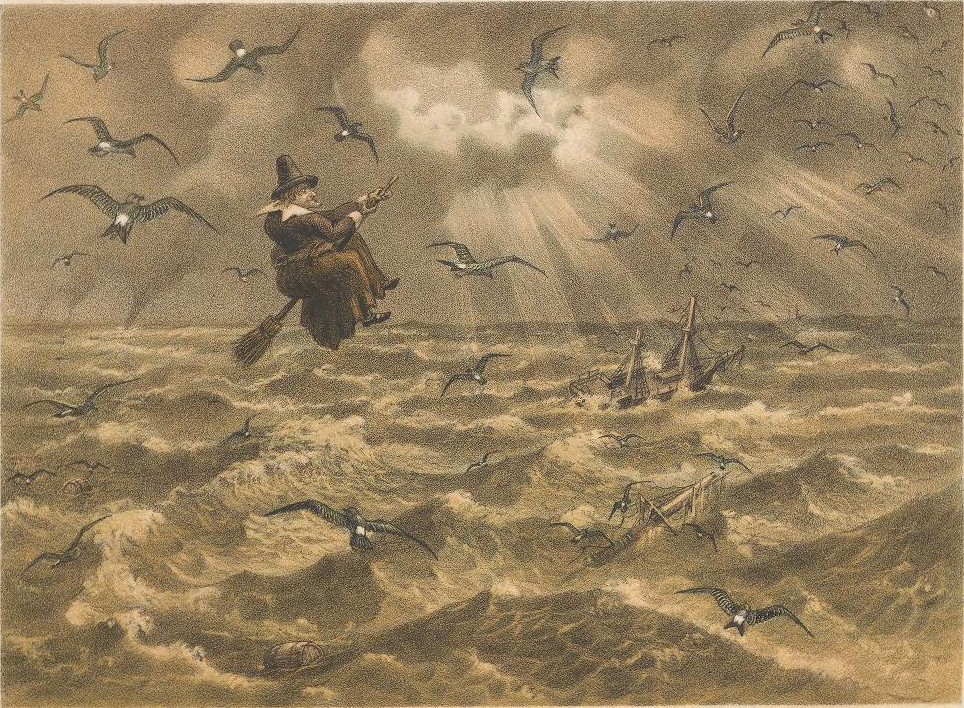
…During the day I have noticed several flocks of “Mother Cary‘s chickens” flying around the brig and skimming over the surface of the water. These little messengers of the deep are of the size and color of a swallow, and are regarded by most sailors with feelings of superstition and reverential awe. Some mariners fully believe them to be the winged spirits of their departed comrades, and consider it a great sacrilege to attempt to capture or kill them. Distance sailed, 202 miles.
Monday, Feb. 12… Distance sailed, 192 miles.
Tuesday Feb. 13.
…Today the caterers of the steerage messes made a complaint to the Captain in relation to the quality and quantity of provisions received by them from the cook. He has promised to provide the steerage passengers with a cook and galley, on the arrival of the brig at Rio. If this promise is not adhered to, a full report of our grievances will be made to the American consul. Distance sailed to-day, 225 miles! Best time yet made. Hurrah for the old tub!
Wednesday, Feb. 14.
Owing to the excessive heat, I slept very little last night, and throughout the day the weather has been very oppressive. Several of the passengers remained on deck last night rather than submit to a vapor-bath in their berths. Took a salt-water bath this evening, and feel very much refreshed. Distance sailed, 184 miles.
Thursday, Feb. 15.
…The morning watch was kept by one of the ship’s boys, a juvenile watch officer! Distance sailed, 134 miles.
Friday, Feb. 16.
We have been becalmed all day within one hundred miles of the equator. Last night the weather was so excessively hot that a majority of the passengers slept on deck.
During the night, four of the first cabin passengers, not having the fear of “delirium triangles” before their eyes, took it into their heads to have a jollification. They made night hideous with their drunken revelry, to the great annoyance and disgust of those who were more quietly disposed.
To cap the climax, one of the revelers had an attack of mania a potu this morning. which I think will have a tendency to check his bacchanalian propensities in future. Distance sailed, 58 miles… “Jerusalem, my happy home,” how hot it is!
Saturday, Feb, 17.
…I slept on top of the cabin last night with nothing but the canopy of heaven for covering… Distance sailed, 30 miles.
Sunday, Feb. 18.
It rained incessantly throughout last night. It seemed as though the flood-gates of heaven had been opened especially for our benefit. The rain ceased at daylight, and a fresh breeze from W.S.W has enabled us to glide along at the rate of seven knots an hour this forenoon.
During the night we caught a barrel of rain-water, which has enabled the passengers to indulge in the luxury of a fresh-water wash, the first since leaving Philadelphia…
We crossed the equinoctial line about ten o’clock, in longitude 25° 40′. Neptune did not honor us with a visit, in consequence, I presume, of its being Sunday. Distance sailed, 83 miles.
Monday, Feb. 19.
Another dead calm throughout today. It seems as though we were never to get out of the “horse latitude.” … Distance sailed, 35 miles.
Tuesday, Feb. 20.
The brig’s awning was spread today for the first time during the passage, although for the past ten days we have, when on deck, been exposed to the broiling rays of a tropical sun. We are still within one degree of the equator, having made only five minutes of latitude during the past twenty-four hours… Distance sailed, only eight miles!
Wednesday, Feb. 21. …Distance sailed… 45 miles.
Thursday, Feb. 22.
…Today being the anniversary of the birth of Washington, the ensign and pennant of the Osceola have been flying in the breeze since daylight this morning. At meridian, a salute with small-arms was fired by the passengers in honor of the day, and several National airs were played by the “El Dorado Band.”
During the afternoon, speeches appropriate to the occasion were delivered by five of the passengers. The jubilee was kept up until a late hour in the evening. Distance sailed, 120 miles.
Friday, Feb. 23.
…An altercation occurred this morning between the Captain and several of the steerage passengers in relation to their ration of Irish potatoes. The Captain and steerage passengers are continually at loggerheads. Scarcely a day passes without a shindy being kicked up between them… Distance sailed, 200 miles.
Saturday, Feb. 24.
…The skirmish that commenced yesterday between the Captain and the steerage passengers, in relation to potatoes, assumed a more warlike aspect this morning, and the old skipper has given orders to the cook to cook no more potatoes for the steerage passengers. He also said he would throw the potatoes overboard rather than have them served to the steerage messes.
This last straw has broken the camel’s back, and a spirit of indignation prevails throughout the brig in regard to Captain Fairfowl’s treatment of the steerage passengers. He is a sea-tyrant, and totally unfit to command a passenger vessel.
The dinner for the steerage passengers today consisted of boiled codfish and hard tack all told! If a more rascally dinner was ever placed before a like number of Christians when on a short allowance of water in a tropical climate, with the thermometer at 85° in the shade, and when surrounded with provisions in abundance, I have yet to learn what it consisted of. The truth of the matter is, there is the devil to pay, and no Irish potatoes to cancel the debt! Distance sailed, 173 miles.
Sunday, Feb. 25.
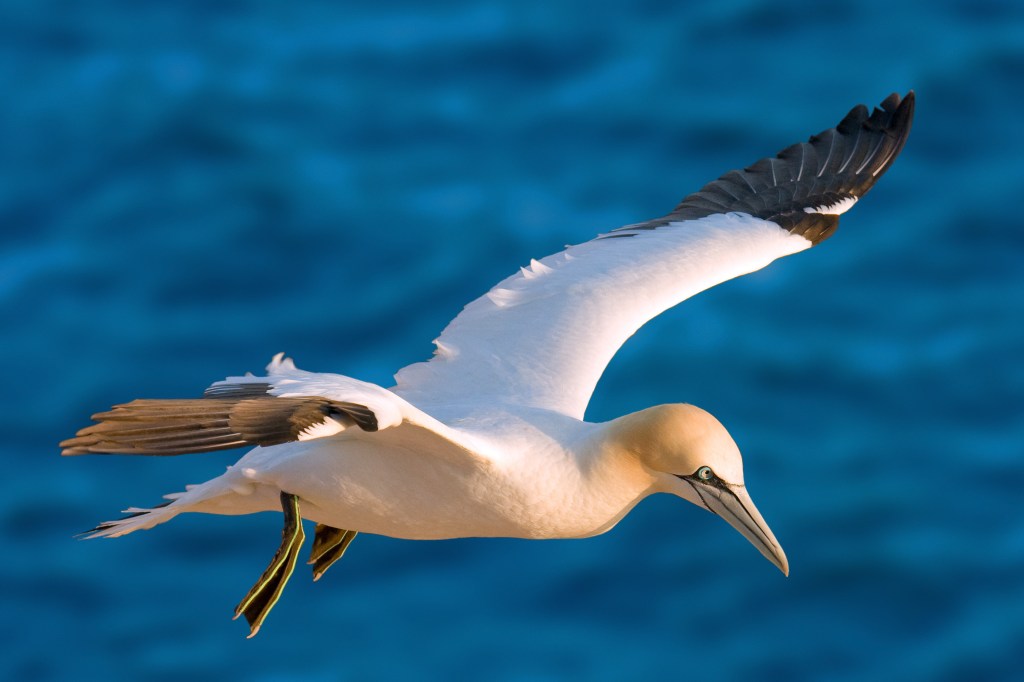
…This afternoon, one of the steerage passengers shot a ganet as it was flying over the brig, but it fell overboard and was lost. The ganet is of the fish-hawk genus, and in size and color of plumage resembles that bird very closely.
The potato war that raged with so much fury yesterday, has gradually subsided. Distance sailed, 163 miles.
Monday, Feb. 26.
Our water, which has been remarkably good until within the past few days, is undergoing the process of fermentation, which renders it very unpalatable… Distance sailed, 170 miles.
Tuesday, Feb. 27.
…During the last three days all hands have been elated with the idea of reaching Rio on Sunday next, but we shall most certainly be disappointed unless favored with a stronger breeze than that of today. We are at this time 900 miles north-east of Rio, yet an eight-knot breeze would waft us there in five days very easily.
Some old sails have been spread above our heads today as a substitute for an awning, and the passengers have been amusing themselves by playing cards, dominoes, backgammon, checkers, and reading, writing, singing, fiddling and dancing.
…To relieve the tedium of the voyage, the passengers have introduced a new game this afternoon pitching pennies, and while I am writing, the pennies are rattling on the deck over my head. Distance sailed…170 miles… Shades of Lucifer! it has been hot today. If I could only divest myself of flesh and sit in my bones for an hour or so, wouldn’t it be altogether lovely?
Wednesday, Feb. 28.
…Since sunrise, this morning, the brig has been rolling lazily along, scarcely making three knots an hour, which does not look much like reaching Rio this week.
Captain Fairfowl has experienced a very sudden change of heart! Yesterday afternoon full naval rations, with the exception of cheese, were served to the steerage passengers, for the first time since leaving Philadelphia. We received no cheese for the very best of reasons there was none on board the brig. The Captain has promised the steerage passengers full naval rations when they arrive at Rio, if the articles of which we are deficient can be had in that port. Among the rations served out yesterday, were butter, pickles and vinegar, the first tasted during the passage.
Our cook is possessed of a devil as large as a ground-hog. The soup for the steerage passengers was served up today in the following novel manner: A large boiler, from the galley, was placed in the lee gangway, exposed to the broiling rays of the sun, and the passengers were called to help themselves as best they could… Distance sailed, 169 miles.
Thursday, March 1
…The forward cabin and steerage passengers have been playing cards and dominoes for dinners, oranges and monkeys, to be purchased in Rio by the losing parties. If the bets are all paid, there will be a scarcity of the raw material in the monkey market… Distance sailed, 173 miles.
Friday, March 2.
This morning the rain poured down in torrents, accompanied by thunder and lightning. Just before the storm commenced two jack-o’-lanterns paid us a visit. One was stationed on the maintop-gallant-yard-arm, and the other on the fore-truck, where they remained until vanquished by the rain-storm. The storm has been succeeded by a calm, and disappointment is depicted in the countenances of all on board…
During today the surface of the water has been covered with a green substance, not unlike that which may be seen on a frog-pond. The sperm-whale is said to subsist on this floating scum. If so, I imagine they will never be troubled with dyspepsia or gout in consequence of high diet… Distance sailed, 130 miles.
Saturday, March 3.
Another severe rain-storm at three o’clock this morning. At the commencement of the rain several of the passengers were asleep on top of the after-cabin, but they were compelled to take up their beds and walk. The storm was succeeded by an eight-knot breeze, which we have carried all day.
Should this breeze continue until eight o’clock tomorrow morning, we shall make Cape Frio, which is seventy miles to the northward of Rio de Janeiro.
Two of the passengers, carpenters by profession, have been engaged during the day constructing a galley for the use of the steerage passengers, which, when completed and manned by a competent cook, will add much to their comfort. Distance sailed, 116 miles.
Sunday, March 4.
A dead calm prevailed throughout last night and to-day. Went on deck this morning at six o’clock and saw Cape Frio directly ahead, about thirty miles distant. To the leeward of us lie the Papagayos. Anchor and St. Ann’s Islands, Cape Busios, St. John’s Hill and Cape St. Thomas.
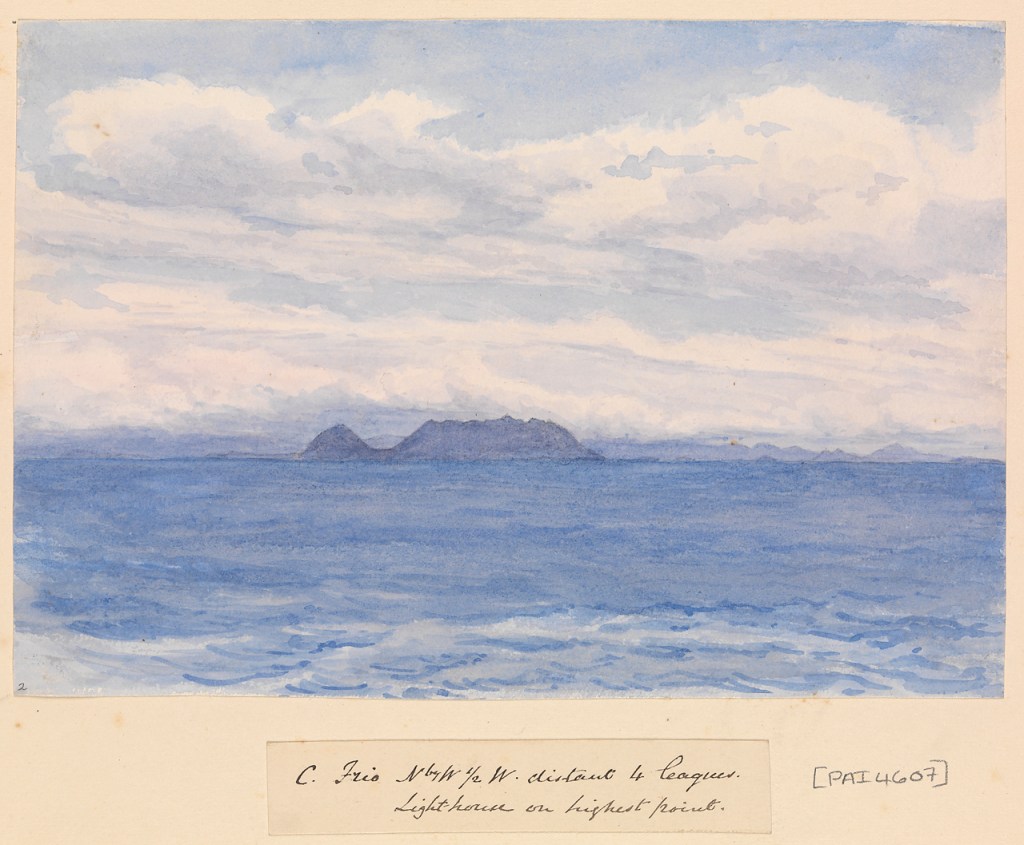
Cape Frio. looming up in the distance, recalled vividly to mind recollections of my boyhood’s home, in consequence of its close resemblance to the Camel’s Hump, one of the highest peaks of the Green Mountain range.
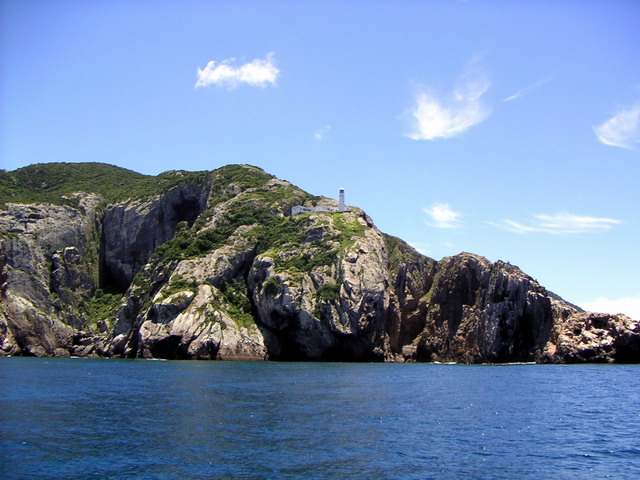
During the afternoon the brig has drifted so near the shore that the light-house on Cape Frio can easily be discerned without the aid of a glass. A half-dozen vessels can be seen from our deck, standing in the same direction with us.
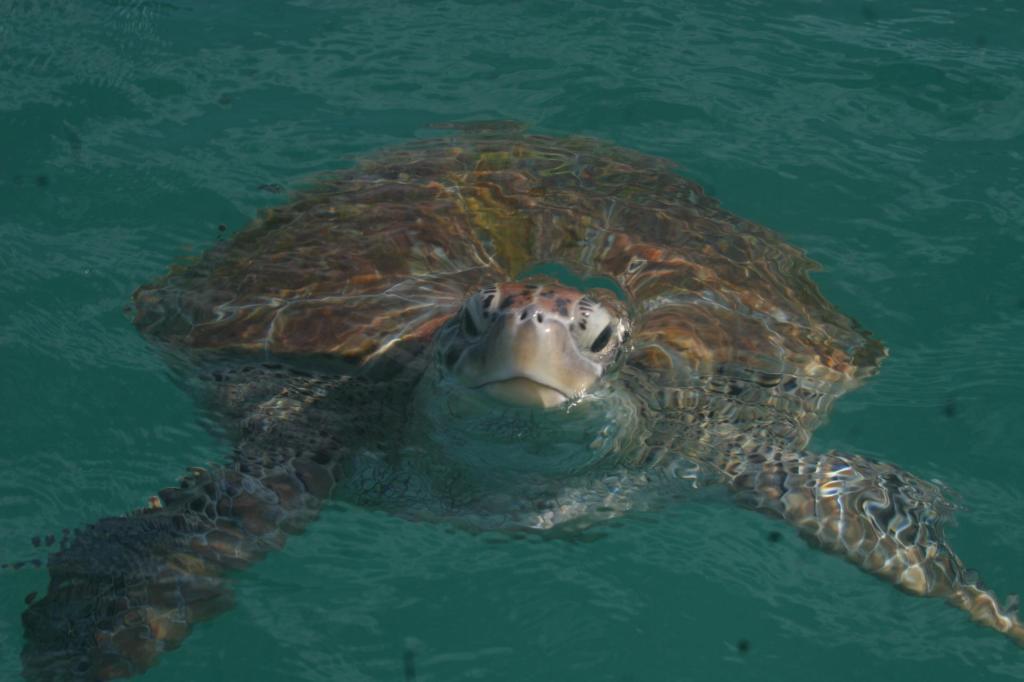
A large green turtle was seen on our weather-bow early this morning, about thirty yards distant, making toward us with head erect. When within fifteen yards of the brig he bade us adieu by shaking his head and “Diving down below, down below.” Distance sailed, 35 miles.
Monday, March 5.
Last night a light breeze sprang up… which enabled us to double Cape Frio. At daylight this morning the wind died away, and during the day we have been rolling about within thirty miles of the harbor of Rio, surrounded by half a dozen vessels similarly situated.
The highlands and mountains of Brazil can be seen along the horizon in the direction of Rio, as far as the eye can scan, and from our main-royal-yard can be seen the Sugar Loaf, a high conical-shaped promontory near the entrance to the harbor.
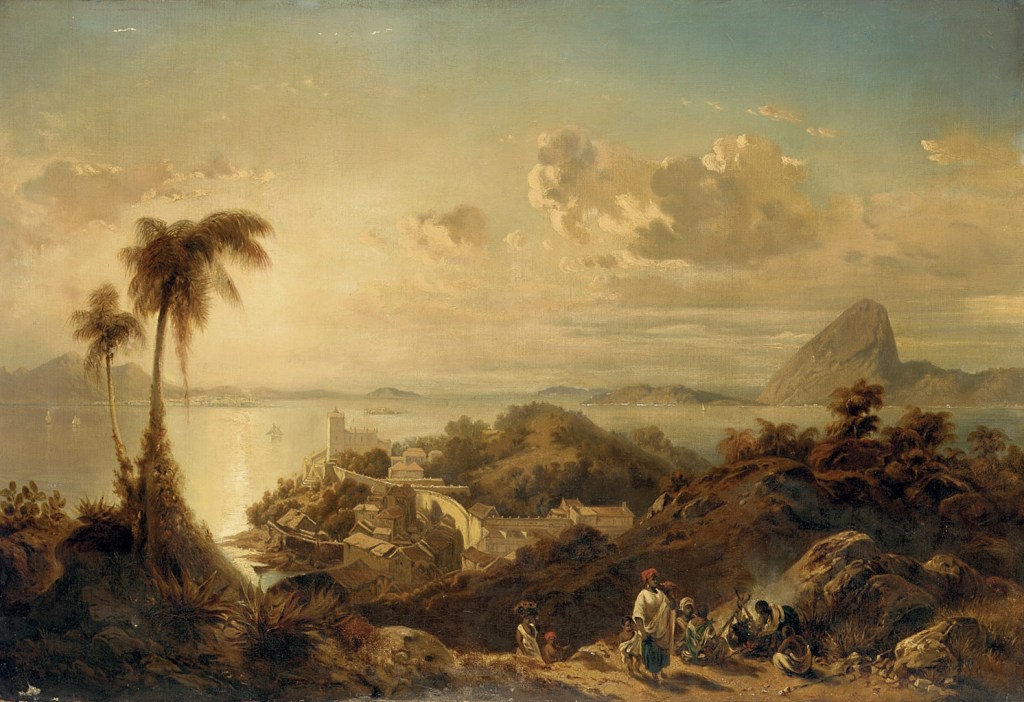
The passengers have been busily engaged today, shaving, shearing and clipping, which has called into requisition all the razors, scissors, hair-dyes, oils and pomades that can be mustered. They are all desirous of captivating the dark-eyed señoritas on their arrival in Rio.
In consequence of the disappointment occasioned by the Osceola’s not reaching Rio today, two of our passengers have adopted the whisky treatment in order to drown their sorrows. Whether they will succeed in calming their troubled spirits remains to be seen, but they have succeeded in making themselves uproariously drunk… Distance sailed, six miles!
Tuesday, March 6
At nine o’clock last night we made the light on Razor Island, at the entrance of the harbor of Rio. We continued our course toward the light until two o’clock this morning when the wind died away and left us within three miles of a rock-bound shore, which was being lashed furiously by the angry waves.
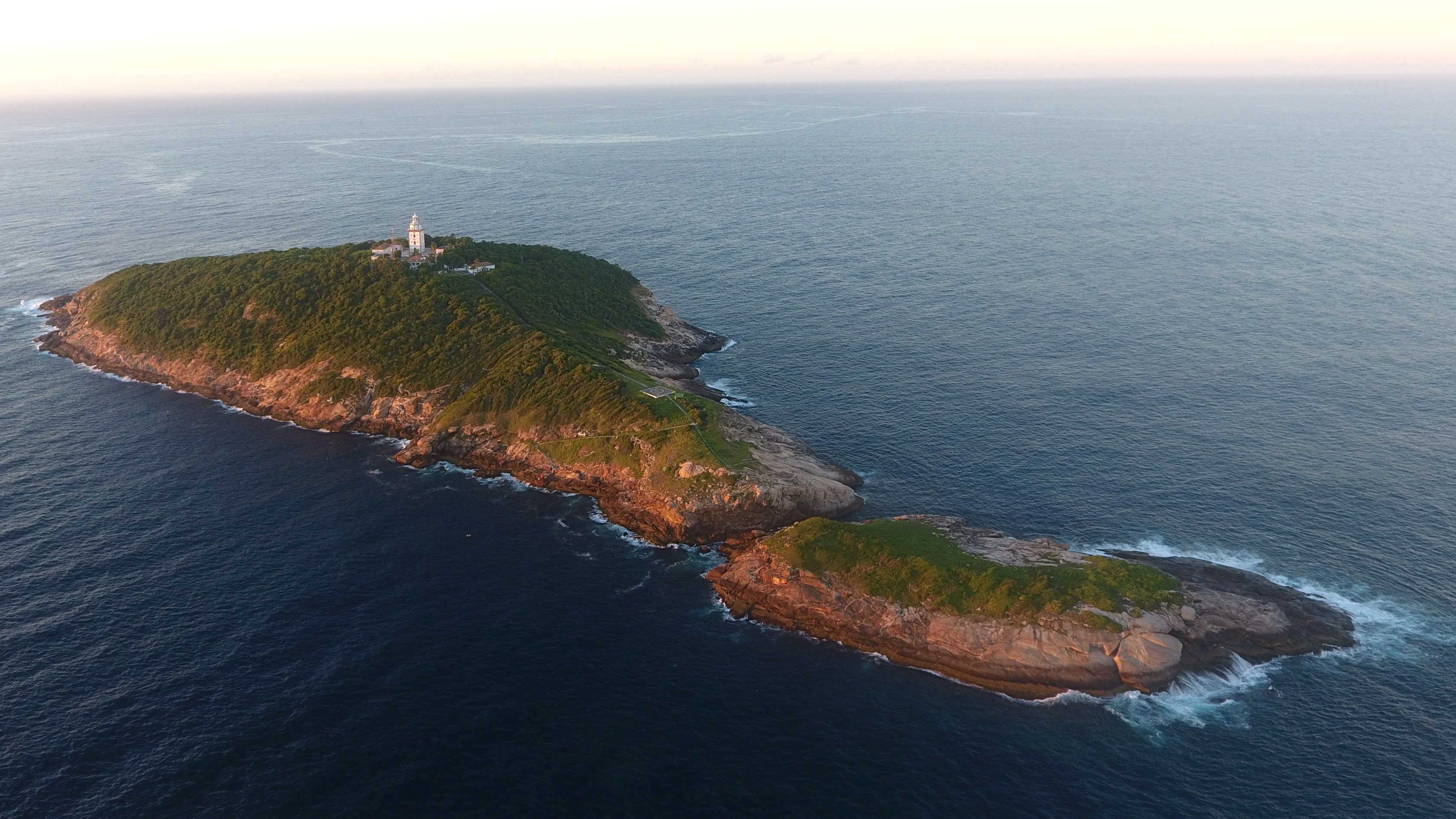
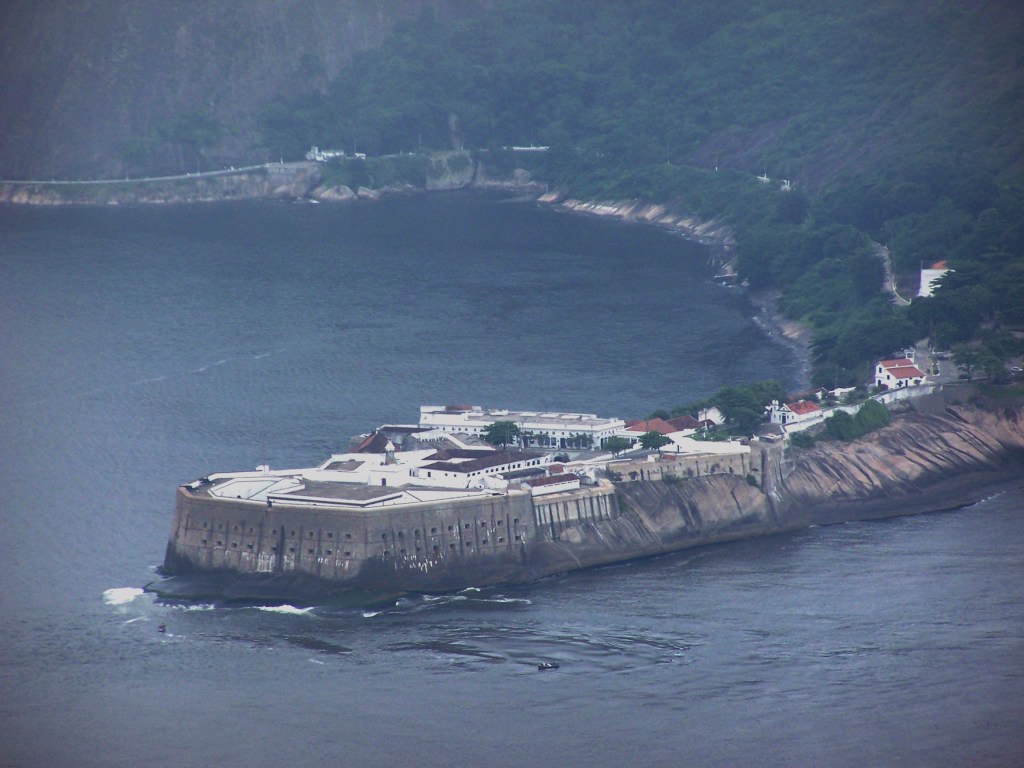
Fortunately, the tide set us off shore, and at daylight the roaring of the breakers was scarcely audible, although the coast for many miles in extent was distinctly in view. Soon after daylight a light breeze sprang up, which enabled us to steer direct for the entrance to the harbor of Rio, which we entered at four o’clock, P.M., and after passing Fort Santa Cruz on the right and the battery at the base of the Sugar Loaf on the left, we dropped anchor about one and a half miles below the principal landing of the city, at five o’clock, P.M.
While passing up the harbor, we spoke the bark Elvira, of Boston, bound out for San Francisco, with sixty-three passengers. Suspended from her main-stay, were several bunches of bananas, which looked very inviting, as I had not tasted fruit of any description for more than forty days.
As we passed Fort Santa Cruz, we were hailed in broken English by a Portuguese official, who thrust his curly head above the ramparts and bellowed through a dilapidated tin trumpet in a Boanergean voice. What he said, we knew not and cared as little, and the reply of our Captain was probably received with like indifference. The custom of hailing vessels from this fort is “More honored in the breach than in the observance.”
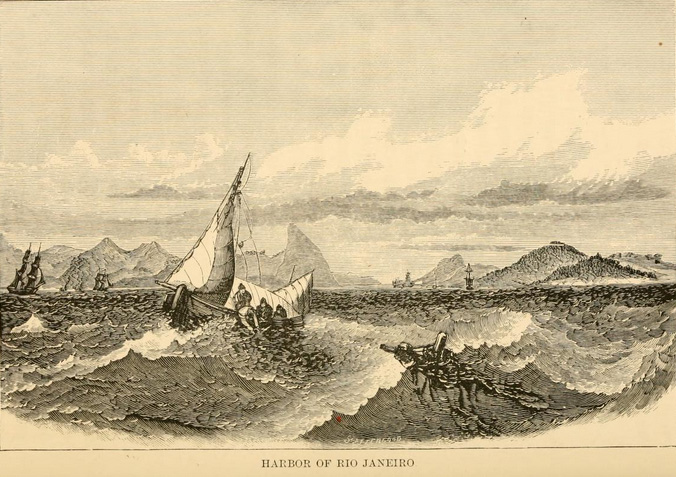
…Our anchor was scarcely down, before the news-boat came alongside. Soon after, we were visited by the Port Physician and the Custom-house officer. They had scarcely left us, before half a dozen shore-boats were alongside manned by half-naked negroes and Portuguese. The boats were soon filled to their utmost capacity by the passengers scarcely a dozen remaining on board and the word vamose being given, we soon passed the guard-ship and were landed on shore at the foot of Palace Square.
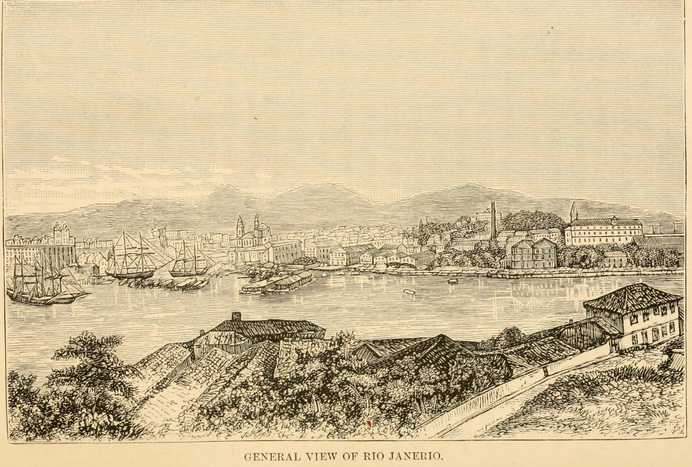
Thus follows 10 days of adventures on land before resuming the journey. But first…
Friday, March 16.
…During the storm last night two of our sailors deserted from the brig, bag and baggage. Our Captain is very unpopular with the crew, as well as with the passengers, and I am fearful he will not be able to ship men in this port to fill the vacancies occasioned by the discharges and desertions from the brig. We are now short two mates and three men before the mast.
The steerage passengers have learned that their table cannot be constructed unless they double-bank
the second tier of berths and stow the lower tier with trunks and other baggage, in order to clear
a space amidships for that purpose. The passengers have all agreed to this arrangement, and tomorrow the table will be rigged up…
Captain Fairfowl came on board about eight o’clock, P.M., very much fatigued!
Saturday, March 17.
I assisted in the steerage today, breaking out trunks and other baggage and arranging the table.
On examination we find that only twenty-six persons can be seated at the table at the same time;
therefore, first come first served will be the order of exercises hereafter…
We have inaugurated our new cook and new galley. The former answers our expectations, but the latter has been tried and found wanting. The boilers are too long. They run through the plate or top of the galley so far that there is not sufficient space for fuel, and unless this defect is remedied we shall be compelled to eat badly cooked food until we reach San Francisco.
The Captain has succeeded today in shipping a first and second mate and one man before the mast, which will enable us to put to sea tomorrow.
Sunday, March 18.
At nine o’clock, A.M., we hove up anchor, got under way and stood out of the
harbor with a fair but light breeze… Distance sailed, 25 miles.
Monday, March 19. …Distance sailed, 140 miles.
Tuesday, March 20.
…Now that the steerage passengers have a table to eat off of, they are no better satisfied than when messing on pig-pens, chicken-coops and water-casks. One thinks his messmate has more elbow-room than himself at the table; another, that he is not treated by the steward with the same degree of attention as his companion; and others imagine that a seat at the head of the table is preferable to one lower down…
Three or four of the passengers are on the sick-list, in consequence of having lived too fast while in Rio. Distance sailed, 184 miles.
Wednesday, March 21.
The breeze of yesterday continued throughout last night and this forenoon, and has placed us 200 miles nearer to San Francisco.
The two mates shipped in Rio have already become dissatisfied with the Captain, in consequence of his interference with their duty while in charge of the deck. I predict that both will be relieved from duty before we arrive in California.
At three o’clock, P.M., the western horizon became suddenly overcast with black clouds, and every indication of a pampero was visible. Studding-sails were accordingly taken in, royals and top gallant-sails furled, top-sails double reefed, the spanker brailed up and everything made ready for the approaching gale, which was soon upon us in all its fury.
The rain descended in torrents, and the wind burst upon us with such violence that every rag of canvas was taken off the brig and she was hove to under bare poles, in which condition she remained during the night. The gale was the most severe that we have encountered during the passage, and I have no anxiety to witness another of the same sort.
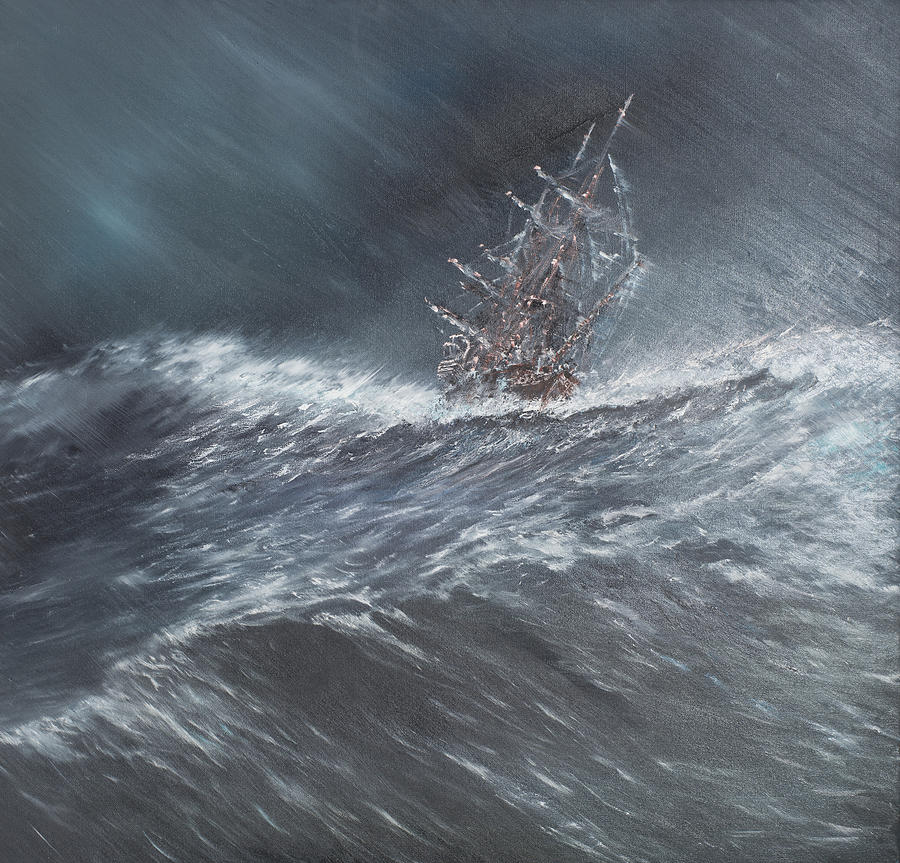
The brig shipped heavy seas during the night, which completely deluged the cabins. The steerage was dry, but such another waltzing of trunks and boxes, crashing of crockery and jingling of tin pans, pots and spoons, I never before heard.
Passengers, as well as baggage and dishes, were in commotion. Some of the former were gliding about clothed in a single garment; others in a state of nudity, genuine model artists, looking as ghastly as ghosts and trembling with fear.
I remained in my berth, but as I could not sleep in consequence of the constant rolling and pitching of the brig, consoled myself by occasionally putting a little whisky where I thought it would do the most good. Distance sailed, 179 miles.
Thursday, March 22.
…During the rough weather last night the steerage galley broke loose from its fastenings, and we have had great difficulty in placing it in its former position, in consequence of the rolling and pitching of the brig… Distance sailed, 30 miles.
Friday, March 23.
…The pampero has been succeeded by the equinoctial storm, and we may be detained in these latitudes several days by adverse winds… This morning, soon after the cook had kindled a fire in the galley, we shipped a sea forward which extinguished it so effectually that it could not be rekindled for several hours. This caused a late breakfast and sour looks among the passengers.
While in Rio, two of our passengers purchased a monkey in co-partnership, and his deviltry has kept them constantly at loggerheads with the Captain and mates.
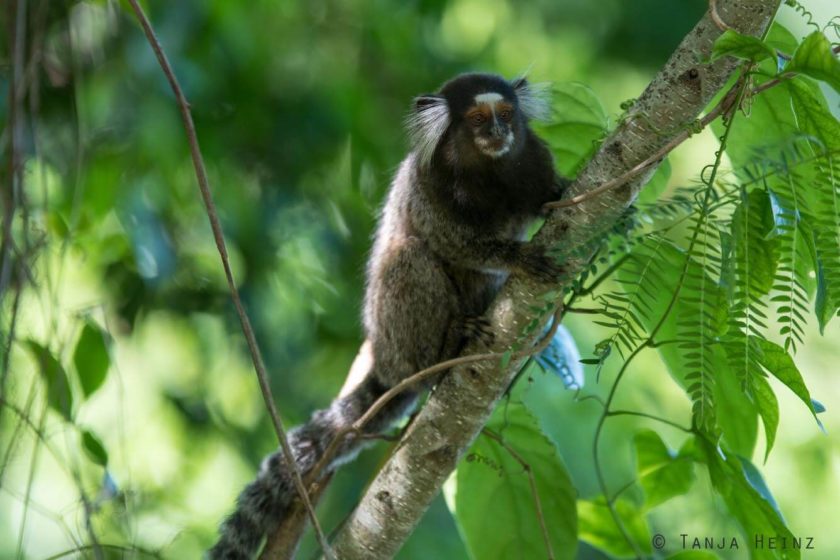
This morning his monkeyship took possession of the nail locker, and the mate threatened him with decapitation should he visit it again. This sanguinary threat having reached the ears of his owners, they informed the mate that they would like to be present when the operation was performed! Distance sailed, five miles!
Saturday, March 24.
…The sea today has been smoother and the brig has rolled less. We are off the mouth of the River La Plata, and may expect at any moment to be visited by another pampero.
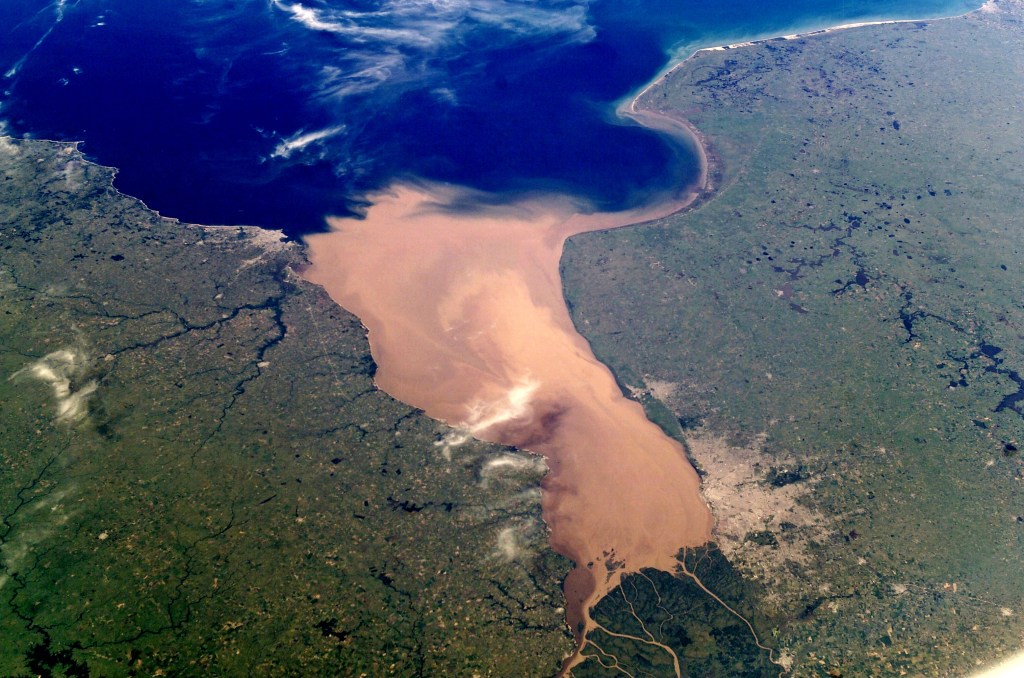
This afternoon the owners of the monkey came to the conclusion that their pet was neither as agreeable a companion nor as profitable an investment as they first imagined, therefore they put him up at raffle, and he was won by the first mate. Distance sailed, 154 miles.
Sunday, March 25.
…The weather is becoming gradually cooler, and the breezes are bracing and invigorating…
Considerable excitement was occasioned this afternoon in consequence of a melee between one of the steerage passengers, a Philadelphia b’hoy, and the second steward. The former accused the latter of mixing the duff with water from the bathing-tub, which he said was “A lie, a damn infernal lie, Upon his soul a lie!” This somewhat excited the b’hoy’s ire, and he gave the steward a blow alongside his visage which caused him to see stars at midday. Distance sailed, 139 miles.
Monday, March 26.
I went on deck at seven o’clock, A.M., and found the brig gliding briskly along with all drawing sails set. Since yesterday, the water has changed from a dark green to a light blue color, but whether caused by the commingling of the water of the Rio de la Plata or other causes, I am unable to state.
This forenoon, while below writing, I heard a tremendous huzzaing on deck, and hurrying up I saw a short distance ahead of the brig a school of porpoises numbering several hundred, puffing, blowing, jumping, skipping and performing all manner of gymnastics. After having amused us half an hour with their feats of agility, they made their exit, playing leap-frog over each other’s backs.
At one o’clock this afternoon the brig was struck by a flaw of wind, which carried away her mainroyal yard. The broken yard was immediately sent down and a new one rigged and sent up. A broken spar floated past us today, which had probably been lost by a vessel off Cape Horn… Distance sailed, 115 miles.
Tuesday, March 27.
During today we have been surrounded by a thick fog, and the weather has been quite chilly. Flannel shirts and drawers, cloth pants and coats, which have been stowed away during the past forty days, made their appearance on deck this morning, and judging from my own personal experience, they were very acceptable… Distance sailed, 189 miles.
Wednesday, March 28.
…the weather has been uncomfortably cold, the thermometer having fallen twenty degrees during the past four days. If the mercury in the thermometer continues to fall in this ratio, it will be frozen in the bulb before we reach Cape Horn. Those of the passengers who did not break out their flannels yesterday, have today donned their red shirts and California mining boots.
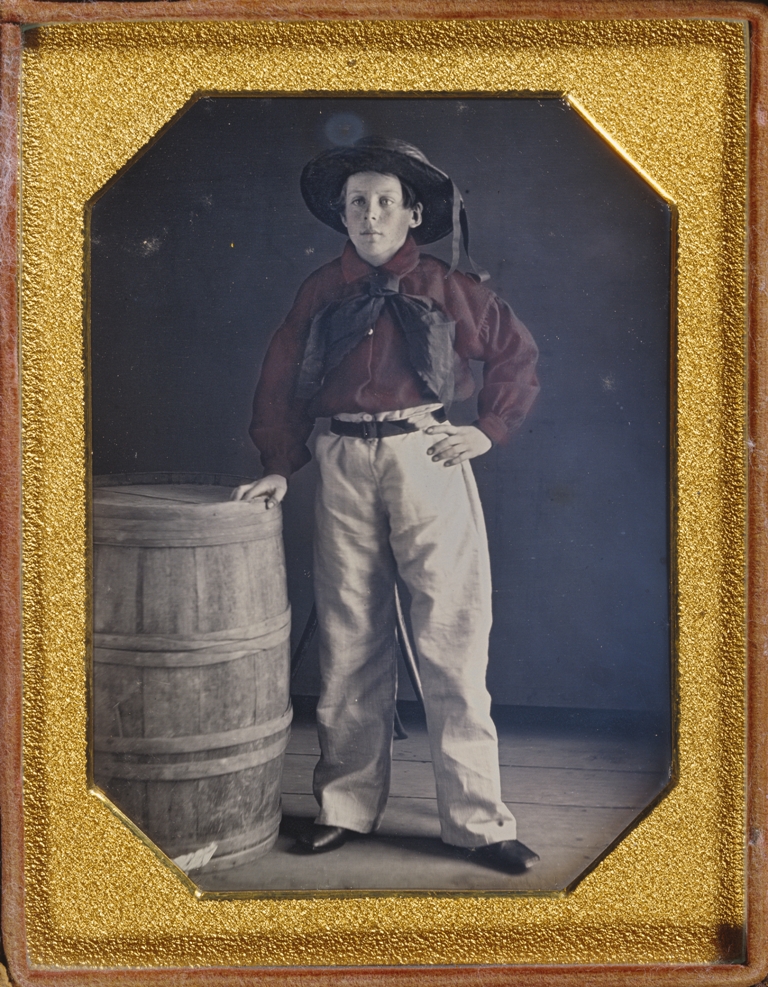
Owing to a strong head-wind the brig has rolled worse and shipped heavier seas today than on any previous occasion during the passage, which has kept both passengers and baggage constantly rolling and sliding about… Distance sailed, 94 miles.
Thursday, March 29.
The wind has been nearly dead ahead all day, which has kept the brig six or seven points off her course. The sea is smoother than it has been for several days past, but the weather is quite winter-ish.
The crew has been engaged today preparing the brig for Cape Horn. The foretop-gallant-mast was condemned and sent down, and a new spar sent up in its place. Sails split and torn since leaving Rio have been repaired, and everything made ready for the coming rough weather.
…This afternoon, a school of whales, numbering forty or fifty, was discovered on our weather-quarter, distant about three miles. They accompanied us until sundown, at about the same relative distance as when first discovered. Distance sailed, 85 miles.
Friday, March 30.
Throughout today we have been favored with a fair wind, and the weather is much milder…
A humpbacked whale made his appearance this morning within 100 yards of the brig, and after blowing several times, shook the spray from his tail and disappeared. Distance sailed, 29 miles.
Saturday, March 31.
…At the commencement of the voyage, the thoughts of doubling Cape Horn in the winter caused “Each particular hair to stand on end, Like quills upon the fretful porcupine;” but the nearer I approach it, the less danger I apprehend in doubling it.
We are now within 800 miles of Cape Horn, and the sea is as smooth as it was off the Cape de Verde Islands. Should the sea remain smooth and the wind continue in the same quarter as now during the next eight days, we shall have passed Cape Horn and reached the placid waters of the Pacific. Distance sailed, 128 miles.
Sunday, April 1.
…At one o’clock, P.M., the barometer fell suddenly, and strong indications of a storm were observable, which caused the Captain to shorten sail forthwith. The men had scarcely laid down from aloft before we were struck by a white squall, which brought the brig down to her bearings and caused the spars and rigging to creak piteously. The gale soon subsided, and we were again gliding briskly over a smooth sea…
Monday, April 2.
…The weather, strange to say, instead of growing colder as we approach Cape Horn, is gradually becoming milder. The thermometer has risen four degrees during the past three days… Distance sailed, 112 miles.
Tuesday, April 3. …Distance sailed, 168 miles.
Wednesday, April 4.
…Heavy head-seas have been running during the day, and the brig has been constantly plunging her head under water and shipping seas, which have completely deluged the forecastle and turned everything in that quarter topsy-turvy. The slush-barrel broke loose and jumped out of the bow-port, and barrel of pork and the grindstone were about to follow suit, when they were secured by the cook and second mate.
This morning, the cook not having the fear of a rope’s end before his eyes, treated the cabin passengers to a pot of salt-water coffee. The circumstance being reported to the Captain, he ordered the knight of the frying-pan and ladle and his assistant aft, and administered to each a quart of saltwater, which they drank with a bad relish, judging from the contortions of their physiognomies.
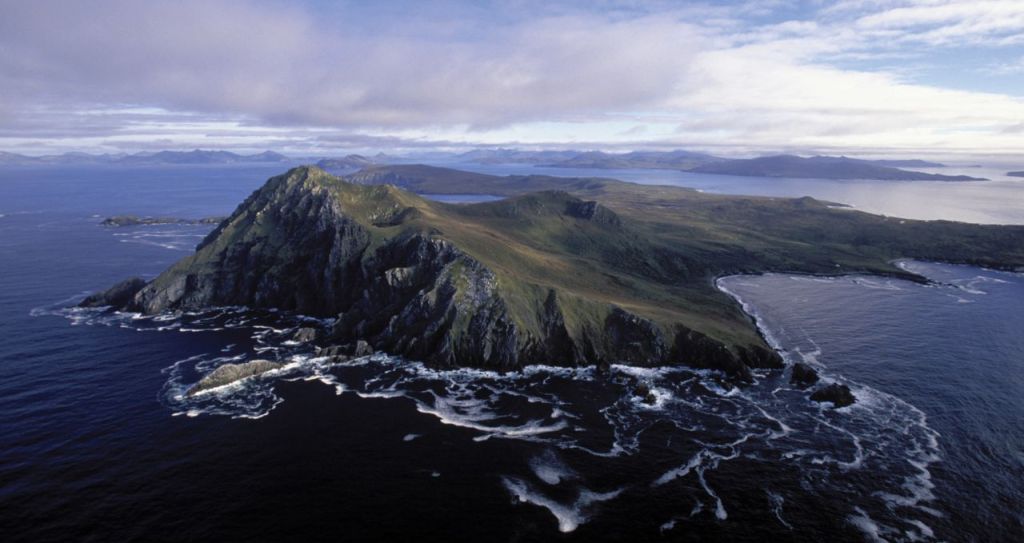
We are today about 40 miles distant from the eastern point of Cape Blanco, on the coast of Patagonia. During the past twenty-four hours the weather has been gradually growing colder, the thermometer having fallen ten degrees. Distance sailed, 115 miles.
Thursday, April 5.
…A mast floated past us this afternoon. It had probably been lost by some vessel off Cape Horn. Distance sailed, 134 miles.
Friday, April 6.
…The weather is so cold that I have remained in my bunk nearly all the afternoon.
Through the negligence of the Captain the cabin stoves have been broken, consequently the passengers have no fires to warm themselves by, which has caused unpleasant feelings. The steerage is at present the most comfortable part of the brig, and it is filled during the day with cabin passengers, some remaining during the night, preferring to sleep on chests rather than occupy their berths in the cabin.
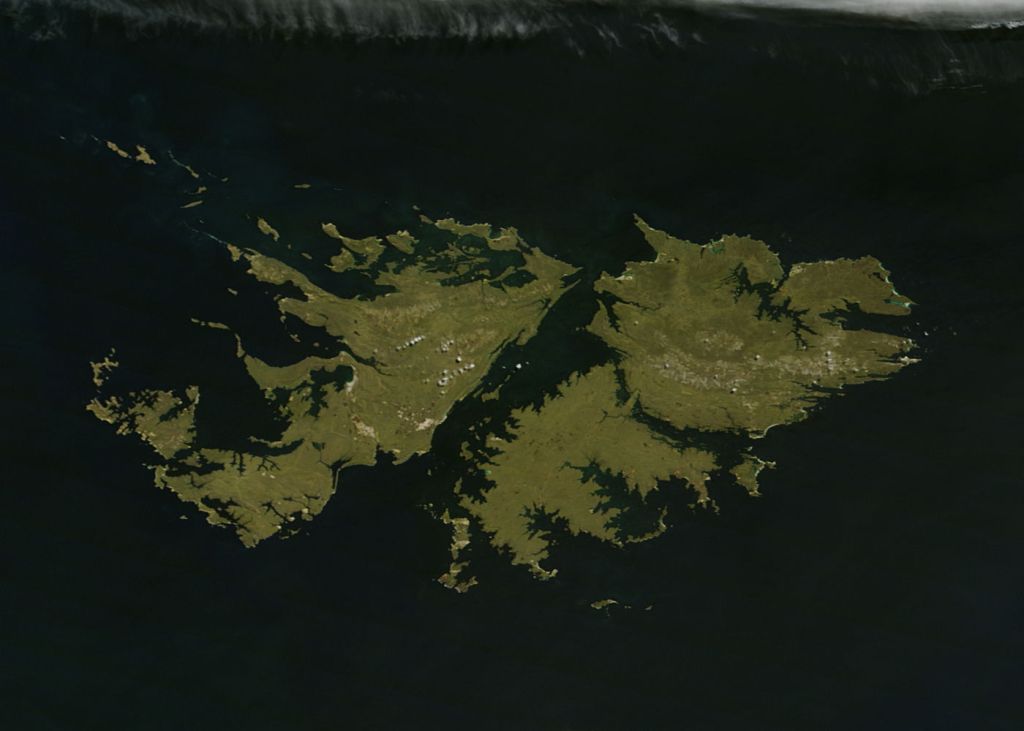
We are today passing between the Falkland Islands and the coast of Patagonia, the former being about 40 miles distant. Distance sailed, 96 miles.
Saturday, April 7.
In the early part of last night we were treated to a specimen of Cape Horn weather in the shape of a hail-storm, which lasted about thirty minutes, during which time hail-stones, from the size of a pea to that of a marble, fell in abundance. After the storm had ceased, the wind freshened, and before ten o’clock it blew a furious gale, before which we were compelled to scud all night.
The brig shipped seas constantly during the night, some of which covered the deck to the depth of three feet, carrying into the lee scuppers everything movable. The deck over my berth leaked like a sieve, and every time the brig shipped a sea I received a shower-bath gratis. Owing to head-winds and cross-seas, the brig has been laboring heavily all day—not making more than three knots an hour, and continually shipping seas.
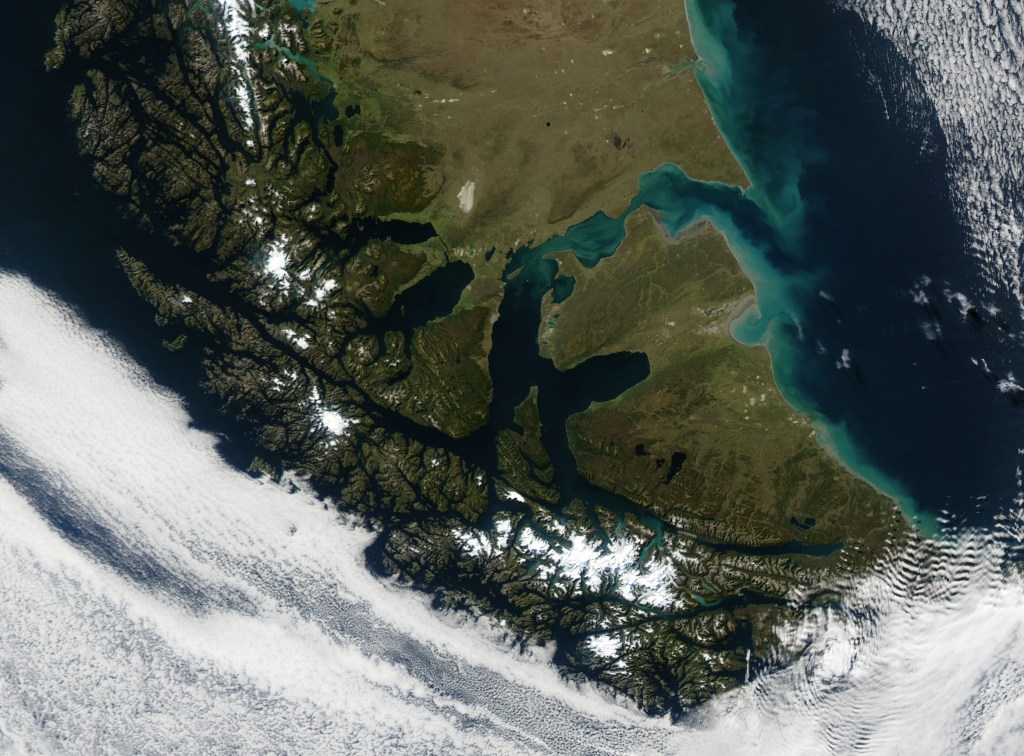
The moon changes today, and I hope the wind will follow suit and enable us to pass around Staten Land and double Cape Horn. At sundown we made Cape St. Diego, the south-eastern point of Terra del Fuego, distant about 25 miles. Distance sailed, 143 miles
Sunday, April 8.
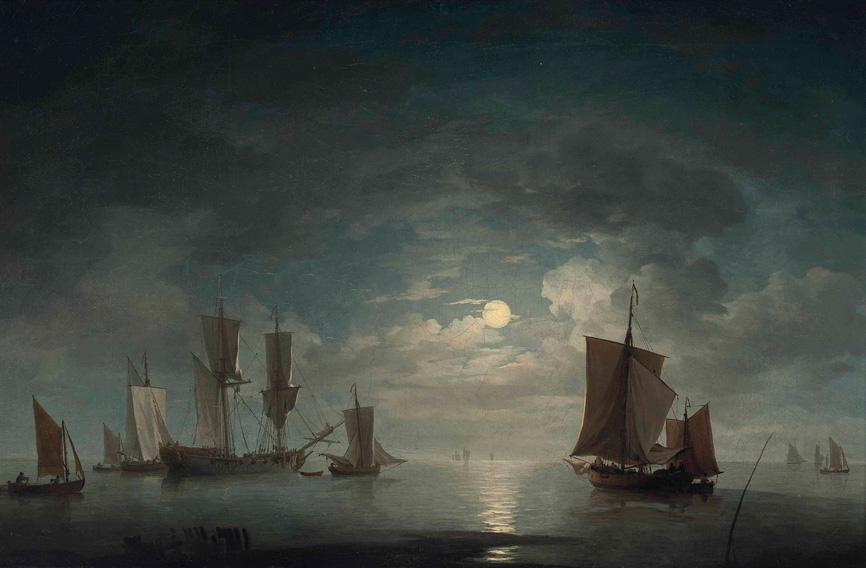
Last night at midnight I went on deck for the purpose of seeing Staten Land. By the aid of the moon, which was somewhat obscured by clouds, I could discern the mountains about 6 miles distant towering to the clouds, their tops covered with perpetual snow.
Staten Land—rock would be the better word—is a mass of barren rocks 60 miles long by 15 miles wide. The highest peaks rise several thousand feet above the level of the ocean, and are continually covered with snow, presenting to the mariner a prospect as cheerless as they are barren and frigid.
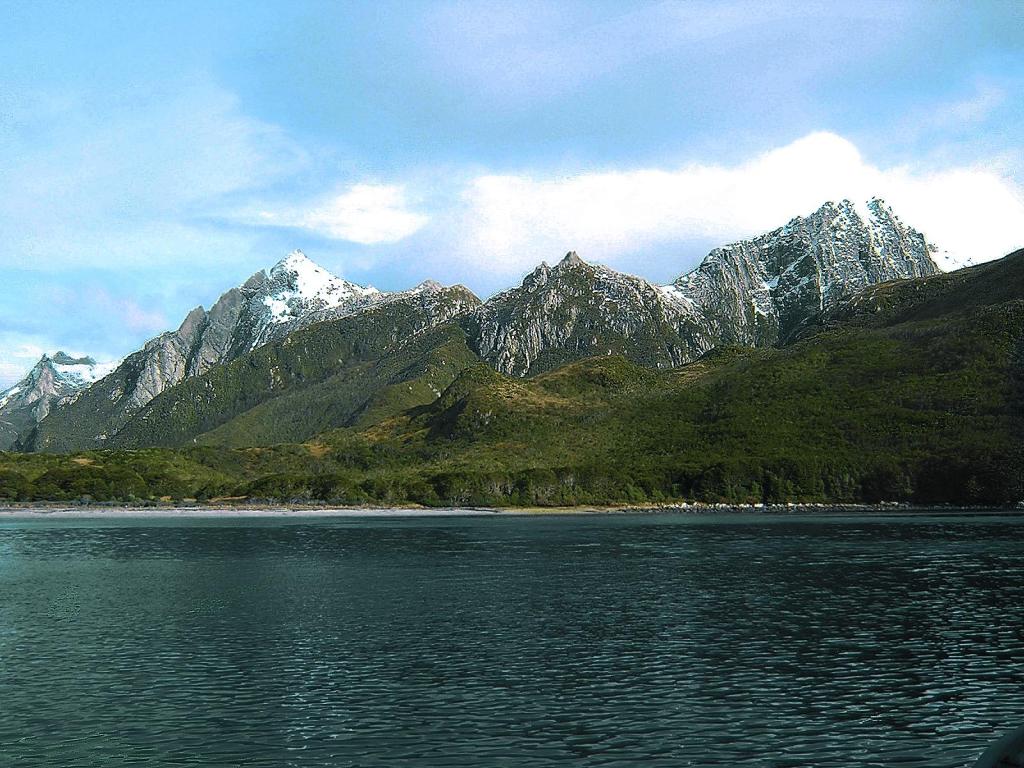
It was the Captain’s intention to have passed through the Straits of Le Maire, thereby avoiding the passage around Staten Land, but as we were about to enter them, the wind chopped around and headed us off.
At three o’clock this morning, we passed around the eastern point of Staten Land… and heading our course toward Cape Horn, which we hope to double tomorrow evening; but all human calculations are uncertain, particularly in this latitude.
…The cold weather of the past week has been too severe for the delicate constitution of our monkey. He had a chill last night, which was succeeded by a violent fever, and this morning at daylight he was so far gone that neither hot drops, quinine nor burnt brandy could save him. At ten o’clock, A.M., he bade farewell to all things sublunary, and at meridian was sewed up in a duff-bag and cast overboard. Sic transit gloria Jocko! Distance sailed, 85 miles. Therm. at M. 43°.
Monday, April 9. …Distance sailed, 94 miles.
Tuesday, April 10.
The wind of yesterday increased toward night, and at ten o’clock, P.M., it blew a furious gale… At midnight a huge wave broke over the forward cabin with such force as to cause several of the passengers to jump out of their berths and commence making preparations for a speedy departure for “Davy Jones’s locker.”…
This morning at sunrise the gale had somewhat subsided, but in consequence of strong head-seas we have made very little progress today. We are still to the south-east of the Horn, distant about 40 miles, but hope to double it tonight… Distance sailed… 50 miles.
Wednesday, April 11.
…There are persons on board the brig who have doubled Cape Horn several times, and at different seasons of the year, and they all say this is the severest gale they ever experienced in this vicinity.
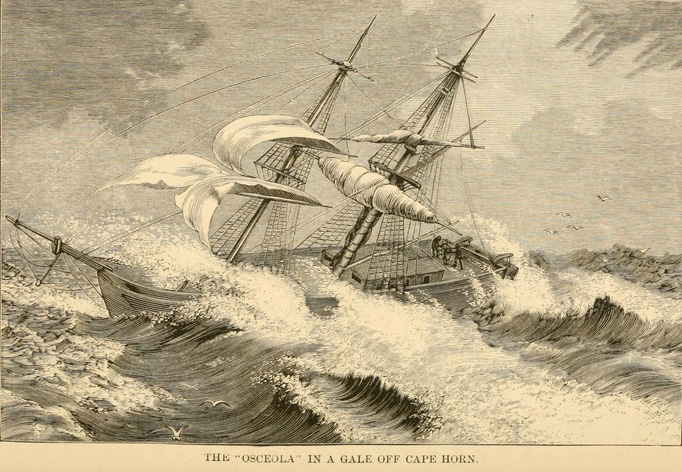
When the gale commenced we were so near the southern extremity of the Cape that the loom of land was visible, and, had we been favored with a fair wind eight hours longer, we would have been steering north-west over the waters of the Pacific. Today there has been no fire in either galley, consequently all hands have been compelled to subsist on low diet—raw salt pork and hard-tack!
At meridian we were 60 miles due south of Cape Horn… Distance sailed, 148 miles.
Thursday, April 12.
…The fresh provisions laid in at Rio for the use of the cabin passengers, gave out yesterday, and all hands on board are now placed on the same diet—salt beef, pork and hard-tack, with an occasional plum-pudding boiled in salt water for dessert!
Yesterday morning, being impressed with a desire to have something fresh for the inner man, either in the way of fish, flesh or fowl, I suggested to a friend the idea of catching a mess of Cape pigeons, which are hovering around the brig in abundance. A fishing-line was accordingly rigged by my friend, and with the hook baited with pork, he caught a half-dozen pigeons before noon.
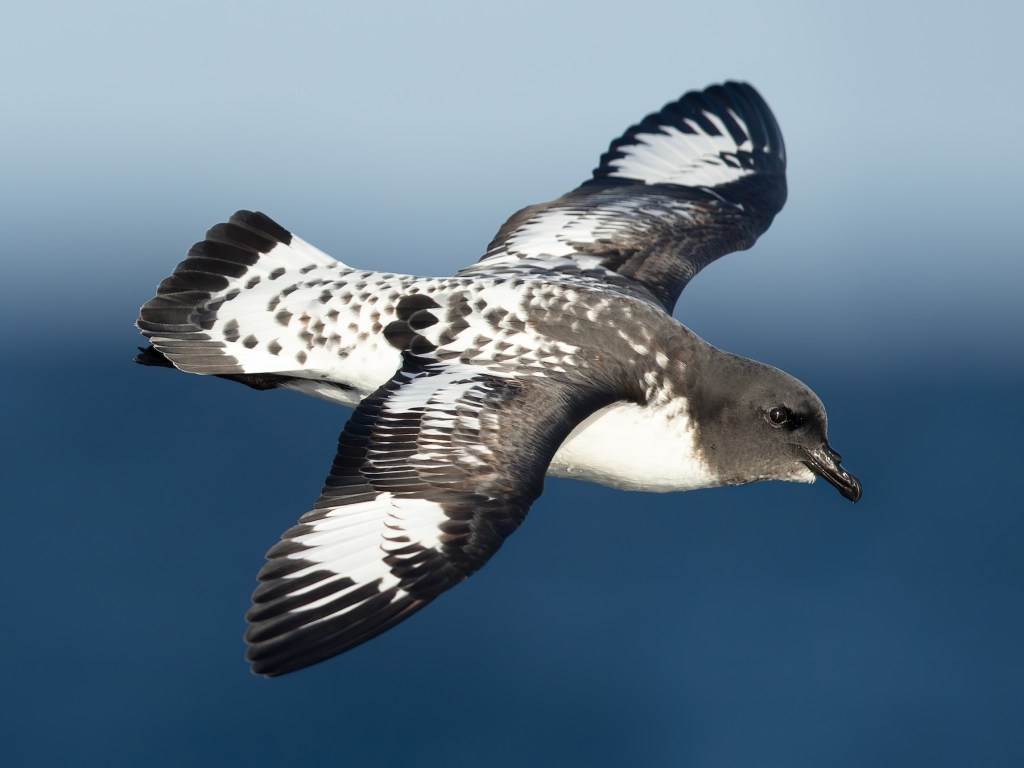
The birds were handed to me for the purpose of being cooked, which operation I performed as well as my limited knowledge of the culinary art would admit of, and at six o’clock, P.M., we sat down to a supper of roast pigeons, stuffed with pork and onions. We ate the pork and onions— the pigeons were thrown overboard! Distance sailed, 50 miles.
Friday, April 13.
…Since the commencement of the stormy weather, the brig has been driven back to the eastward as far as Staten Land, and so long as this head-wind continues we shall drift still further eastward. We are further south this morning than at any time since we rounded Staten Land, and judging from the coldness of the wind, I presume we are in the vicinity of icebergs and fields of floating ice.
The thermometer has fallen seven degrees in the past twenty-four hours, and being without stoves or fires brings forcibly to mind scenes in the Antarctic… Distance sailed, 84 miles. Therm. at M. 35°.
Saturday, April 14.
…The wind has been fair all day and the sea quite smooth, which has enabled us to leave the frozen regions of the south pole for those of a more genial temperature, at the rate of eight knots an hour… Distance sailed, 106 miles.
Sunday, April 15.
…At meridian, Cape Horn bore northeast, distant 125 miles; therefore we are at last in the Pacific! Three cheers and a “tiger” for the Osceola!
This morning the Captain and second mate had an altercation in relation to the duties of the latter, which resulted in his being “broken” and ordered in the forecastle to do duty before the mast during the remainder of the voyage. It now remains to be seen whether the Captain will keep the “broken” mate’s watch on deck or request the passengers to perform that duty, as was the case previous to our arrival at Rio de Janeiro. Distance sailed, 112 miles.

Monday, April 16.
…Now that we are safely around Cape Horn, all hands are more anxious than ever to reach San Francisco, and in order to induce the Captain to carry a little more canvas on the brig, eight or ten of the passengers have volunteered their services to assist the crew in working her during the balance of the voyage… Distance sailed, 80 miles.
Tuesday, April 17.
…During the past twenty-four hours, the brig has completely boxed the compass. Last night she headed west; this morning, at seven o’clock, north-west; at meridian, north; at two o’clock, P.M., south-east; at five o’clock, P.M., south, and at this writing, seven o’clock, P.M., she is heading south-west by west, which course the Captain desires to run until tomorrow noon, when, the wind permitting, he will steer northward.
Our volunteers performed their duty last night to the entire satisfaction of the Captain, but the damp and chilly weather of today has completely disheartened them. Three of the volunteers have made up their minds not to stand watch tonight, and have already turned into their berths. Distance sailed, 148 miles.
Wednesday, April 18. …Distance sailed, 102 miles.
Thursday, April 19. This afternoon one of the passengers caught an albatross measuring across the wings from tip to tip, seven feet and two inches. It was captured with a hook baited with pork. Having been inspected by all hands, it was placed in the chicken-coop for safe-keeping …Distance sailed, 94 miles.
Friday, April 20.
At eight o’clock, A.M., we were struck by a squall which carried our foresail completely out of the bolt-rope, and the yards and masts would have gone by the board had not the passengers jumped on deck and assisted the crew in taking in sail and making things secure.
The first mate had charge of the deck at the commencement of the squall, but in consequence of his tardiness in the management of the brig, he was relieved by the Captain, who immediately clewed up and furled every sail with the exception of the foretop-mast-stay sail, under which we have been laying to during the forenoon.
The squall has increased to a gale, and at this time, three o’clock, P.M., the wind is blowing a hurricane, which is drifting the brig toward Cape Horn at the rate of six knots an hour.
After the gale had partially subsided, the Captain called the mate aft and read him a lecture on the management of a vessel in a storm, every sentence of which was rounded off with an oath*, which drove the subject home and clinched it effectually. Distance sailed, 80 miles.
*“A casual or careless appeal invoking God (or something sacred) in asseveration or imprecation, without intent of reverence, made in corroboration of a statement, declaration, etc.; a profane or blasphemous utterance; a curse. Also: any strong expletive expressing anger, frustration, etc., often with substitution for, or omission of, a sacred name.” – Oxford English Dictionary
Saturday, April 21.
The gale of yesterday continued throughout last night, during which time I did not close my eyes, for fear of being thrown out of my berth by the continual rolling of the brig. This storm is the severest we have encountered during the passage—the barometer at one time being as low as 29°.
Early this morning the mainsail, top-sail, spanker and jib were set, a new foresail broke out of the sail-room and bent on… Distance sailed, 64 miles.
Sunday, April 22.
…Last night our amateur sailors again volunteered their services, and worked like Trojans, pulling and hauling at the ropes.
My feet have been very sore the past week, and today they are so badly swollen that it is with great difficulty I can draw on my boots. One-third of the passengers are similarly afflicted. Whether this swelling of the feet is occasioned by chilblains or the scurvy, I am unable to state, but am inclined to the belief that it is the incipient symptoms of the latter disease. Distance sailed, 130 miles.
Monday, April 23… Distance sailed, 118 miles.
Tuesday, April 24.
…The Osceola seems to have fallen desperately in love with Cape Horn, and appears loath to leave, judging from the manner in which she is dodging around in this region. We are no farther from Cape Horn than we were ten days ago, and God only knows when we shall be permitted to leave this locality. A strange fatality seems to hang over us! Who is the Jonah? Distance sailed, 114 miles.
Wednesday, April 25… This evening one of the passengers shot an albatross which fell on deck. The wings were given to the steerage steward; the skin and feathers were retained by the person who killed the bird, and the carcass will be served up to-day at two o’clock, P. M., for the especial benefit of steerage mess No. 1. Thank God, I don’t belong to that mess! I can eat albatross, but I don’t hanker after it. Distance sailed, 110 miles.
Thursday, April 26.
…One hundred days since we left Philadelphia, and we are not 30 miles to the northward of Cape Horn. Should the latter part of our voyage prove as tedious and unpleasant as the first, we shall all hail with joy the land of promise to which we are bound, whether we realize fortunes or not. If ever sixty-five individuals were more heartily disgusted with a sea voyage than are the passengers on board this brig, I have yet to make their acquaintance. Distance sailed, 144 miles.
Friday, April 27.
…An altercation occurred this morning between two of the cabin passengers, which caused a general rush toward the scene of action. During the affray one of the combatants drew a knife from his pocket, which was secured and thrown overboard before he had an opportunity of using it on his antagonist…. Distance sailed, 98 miles.
Saturday, April 28.
…The past week the gambling fever has again been raging fiercely on board, several of the cabin passengers having bucked away their last cent. Some of them have become so infatuated with this damnable vice that they have cut the buttons from their coats, vests and inexpressibles, for the purpose of playing button bluff. Distance sailed, 134 miles.
Sunday, April 29.
…The old skipper turned out of his berth this morning in a very bad humor, and during the day has, to use a nautical phrase, been “working up” the sailors. They have been employed all day moving the larboard chain cable aft on the quarter deck, for the purpose of bringing the brig down more by the stern, thereby enabling her toil faster and make less leeway. Sunday brings no rest for poor Jack.
“Six days shalt thou labor/And do all thou art able/On the seventh, wash decks/And haul aft the cable!” Distance sailed, 101 miles.
Monday, April 30.
…A cold rain has been falling since morning which has caused the passengers to remain in close quarters all day.
A faro-bank has been in operation in the after-cabin this afternoon, and several hundred dollars have changed hands. At sundown the bank was closed, but after supper it was again opened, and at this writing, eight o’clock, P.M., I hear the checks rattling on the table over my head… Distance sailed… 114 miles.
Tuesday, May 1.
Early last night the wind commenced blowing furiously from the north-west, and at midnight we were in the midst of a hurricane… Distance sailed, 35 miles.
Wednesday, May 2.
The gale continued to rage throughout last night with increased violence. During the night, the brig shipped several of the heaviest seas I ever saw break over the bow of a vessel. She shipped one in the early part of the evening that washed the steerage cook and a ship’s boy out of the galley and carried them on an excursion down the lee scuppers as far as the companion-way, where they brought up hard and fast against a chicken-coop jambed between a water-cask and the bulwarks.
The brig rolled so heavily all night that several of the passengers on the weather-side were pitched out of their berths among the trunks and boxes. Fortunately no bones were broken.
At daylight this morning the gale subsided, the wind hauled to the south-west, and we have been heading our course with all drawing-sails set, but a strong head-sea has prevented us from making much headway… Distance sailed, 28 miles.
Thursday, May 3.
Throughout last night the weather was squally with frequent showers. Since sunrise the wind has been on the increase, and strong indications of a gale before midnight are visible. …this afternoon the brig has been completely enveloped by a dense fog… Distance sailed, 116 miles.
Friday, May 4.
…The Captain says, and he is in dead earnest, that there shall be no more gambling on board the Osceola, but all hands, including the cook, have permission to pray as long and as loud as they please. Tally one for Captain Fairfowl.
Now that gambling has been squelched, the Captain predicts a fair wind within the next twenty-four hours. We shall see. Distance sailed, 72 miles.
Saturday, May 5.
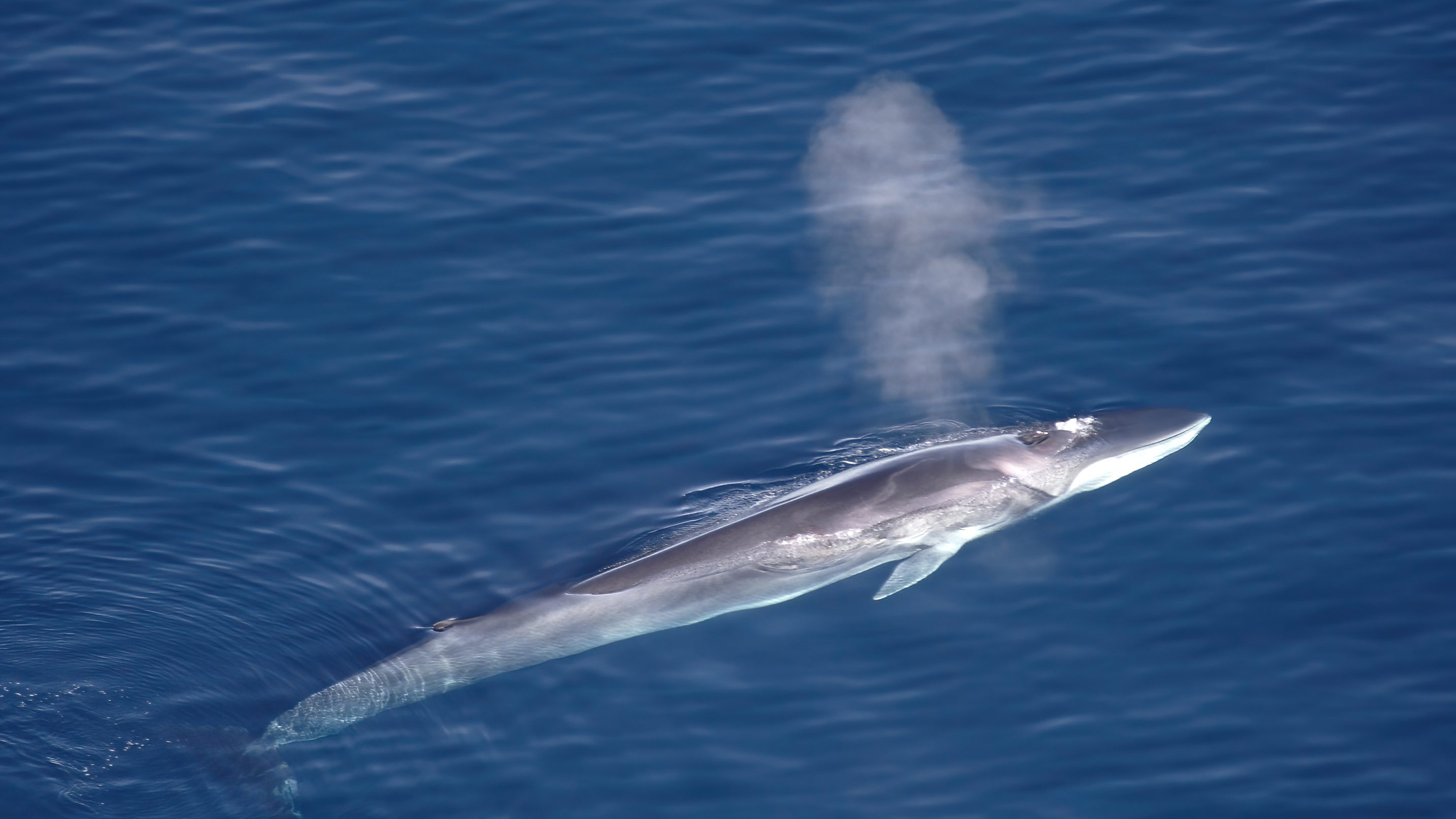
…This morning I had a fine view of a finbacked whale, which I should judge would measure sixty feet in length. Distance sailed, 110 miles.
Sunday, May 6.
…Today the passengers have had their mattresses and blankets spread on deck for the purpose of giving them an airing, which they needed very much… Distance sailed, 140 miles.
Monday, May 7.
…The weather is becoming more mild and pleasant, and “life on the ocean wave” seems more endurable. The passengers who have been shivering with the cold weather for the past twenty days, are skipping about the deck as lively as larks, enjoying a little sunshine. The mercury in the thermometer marked 53° to-day, being the first time it has reached that point in thirty days.
All hands were very much amused today by a novel punishment inflicted on one of the ship’s boys. A pig, weighing twenty pounds, was slung under the right arm of the culprit by a lashing that passed over his right shoulder and around the body of the porker. Thus accoutred, he was ordered by the Captain to march around the deck twelve times, which command he obeyed to the infinite amusement of all hands, who lined the deck on either side.
The scene reminded me of a Scotch piper. At every step he jerked his elbow into the side of poor piggy, at the same time pinching his ear, which caused his porkship to discourse most shrill and discordant music. Distance sailed, 184 miles.
Tuesday, May 8.
…We have, in the last fifty hours, made nearly 500 miles on our course, which is very gratifying to all on board. Yesterday, when the latitude was reported by the Captain, all hands gave three cheers and a “tiger,” which seemed to shake the brig from stem to stern, and add fresh impetus to her speed… Distance sailed, 190 miles.
Wednesday, May 9.
…The weather is delightfully pleasant, and all hands are on deck indulging in a sun-bath.
…This morning the Captain altered the course of the brig, and since that time we have been steering direct for Talcahuana, where we hope to arrive day after tomorrow…
This evening one of the passengers had a severe attack of the cramp colic which came very near causing him to lose the number of his mess. Distance sailed, 180 miles.
Thursday, May 10.
…The anchors were gotten over the bow this afternoon, the chain cables hauled forward and shackled, and everything forward made ready for coming to anchor. During the afternoon the tops and yards have been crowded with passengers watching for land, but they have been disappointed, no land being visible at sundown.
Yesterday morning, the second mate was called aft by the Captain and restored to duty, and during the remainder of the voyage he will be entitled to the privilege of sleeping in the steerage and eating his meals in the cabin or galley… Distance sailed, 143 miles.
Friday, May 11.
We steered our course all last night, but this morning the wind hauled around to the northward and headed us off three or four points. At meridian the Captain informed us that we were 40 miles to the leeward of Talcahuana, therefore there is little hope of reaching that port tomorrow unless the wind becomes more favorable.
This forenoon land was reported half a dozen times by different individual, but like the Frenchman’s flea*, when they looked the second time it was not there. At sundown, however, terra firma was really discovered on our lee-bow, distant about 30 miles. Another school of whales visited us this afternoon, and after following in our wake for an hour turned flukes and disappeared. … Distance sailed, 112 miles.
*Apparently there is an old joke which undergirds this reference, but ironically trying to find it is rather self-prophetic, as I can only find similar references like this, but not the joke itself…
Saturday, May 12.
The wind continued ahead all night, and in order to work the brig as far to the windward as possible, the Captain wore her at the commencement of each watch.
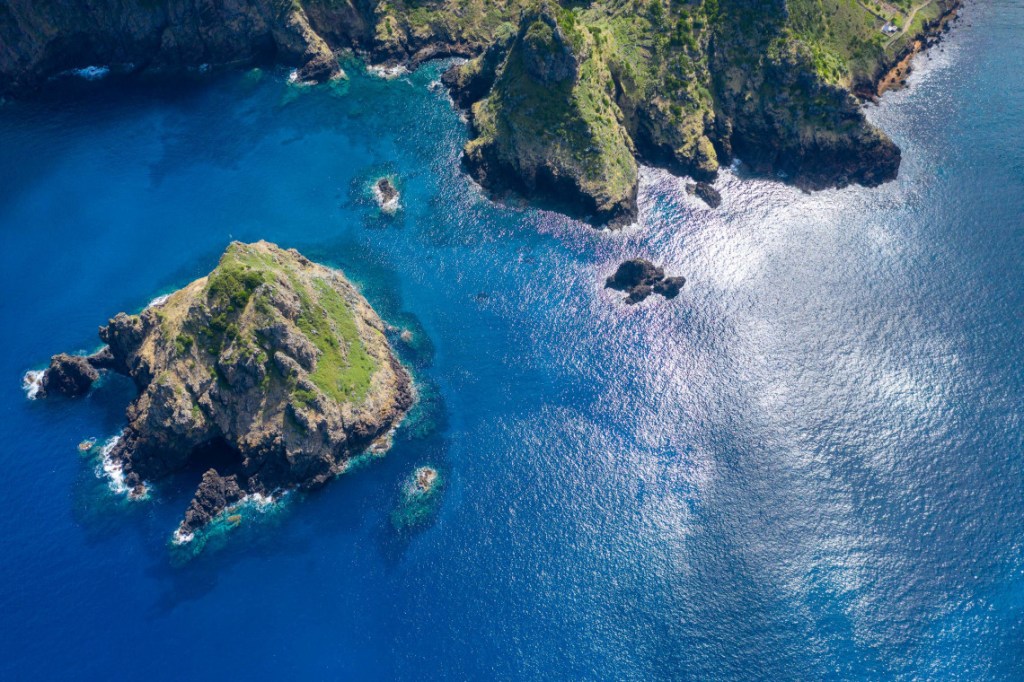
At daylight this morning, the Island of Santa Maria and the Paps of Talcahuana were distinctly in view; the latter on our weather bow, distant 137 about 30 miles. We continued beating toward the harbor during the forenoon, and would probably have come to anchor ere this had we not encountered a norther, which compelled us to give the land a wide berth; therefore the Captain wore the brig and stood to the westward, which course we are steering at this time…
The Captain and first mate had another growl in relation to the duty of the latter, and during the wrangle the lie direct was given on both sides. The old skipper swears that he will discharge the first mate on our arrival in Talcahuana, and the second mate says if the Captain does not serve him in like manner he will take the liberty of discharging himself. It is probable that both mates will be discharged at that place and other officers shipped to fill the vacancies. Distance sailed, 40 miles.
Sunday, May 13.
…During last night we were driven so far to the southward and westward that we did not make the land again until five o’clock this evening. At sundown we were about 15 miles 138 to the windward of the harbor of Talcahuana… Distance sailed, 70 miles.
Monday, May 14.
Last night about eight o’clock we came very near running aground on a reef off the harbor of Talcahuana, which caused a panic among the passengers. We hugged the land closely during the night, and at daylight this morning discovered through the fog an opening, into which we ran, the Captain supposing it to be the harbor of Talcahuana, but soon discovering his mistake, let go the anchor.
When the sun had dispelled the fog, we found ourselves in a small bay, the name of which we could not determine. We could not put to sea, as a stiff breeze was blowing directly into the mouth of the bay; therefore the Captain concluded to go ashore and ascertain his where abouts. The skipper gave the passengers permission to accompany him, and the boats were soon filled and pulling for the shore with willing hands…
Thus follows all sorts of stuff and nonsense being held up by the Chilean government for landing in the wrong bay…
Wednesday, May 23.
…Both of our mates have been discharged, and the Captain is again without officers. We have had four mates since we left Philadelphia, and God only knows how many more we shall have before we reach California.
Two sailors came on board the Osceola today and volunteered to work their passage to San Francisco, and the offer has been accepted by Captain Fairfowl. Our provisions and water are now all on board, and if we had our clearance papers we should sail without mates.
Sunday, May 27.
…After breakfast the anchor was hove short, and at ten o’clock, A.M., we received our clearance papers from the Port Captain, got under way, and at meridian passed the Island of Quiriquina, at the entrance to the harbor, and were soon at sea, gliding merrily along over the swelling billows of the Pacific.
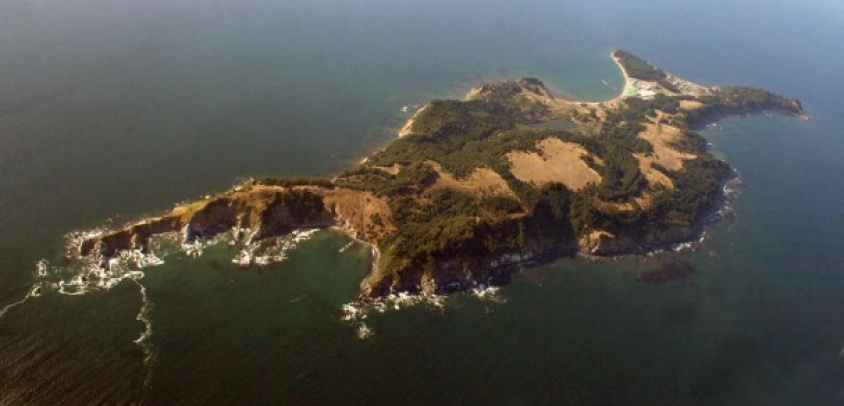
At the mouth of the harbor we spoke the California passenger ship Christoval Colon, of New York, bound in for a supply of provisions and water… As we passed the Christoval Colon, cheers were exchanged, and our band, consisting of a bugle, cornet and trombone, struck up the “Star-Spangled Banner,” which was cheered at intervals by the passengers of the Colon and Mary Wilder, until their voices were drowned by the dashing of the waves against the prow of the Osceola.
As soon as we were outside the harbor, studding-sails were set below and aloft, and the coast of Chili rapidly disappeared in the distance.
Monday, May 28.
…This morning angry words passed between the after-cabin and steerage passengers in relation to their rights on shipboard. One of the former intimated that the steerage passengers had no right to promenade the quarter-deck. This brought the steerage boys out in full force, and a long controversy ensued, in which both parties took an active part.
The matter was finally referred to the Captain, who decided that the steerage passengers had the same right to the use of the quarter-deck as their aristocratic neighbors of the cabin. The opinion among the steerage passengers today is, that Captain Fairfowl’s head is perfectly level. Distance sailed, 147 miles.
Tuesday, May 29.
…At meridian we were off the Island(s) of Juan Fernandez, once the abode of “poor old Robinson Crusoe.” …Distance sailed, 91 miles.
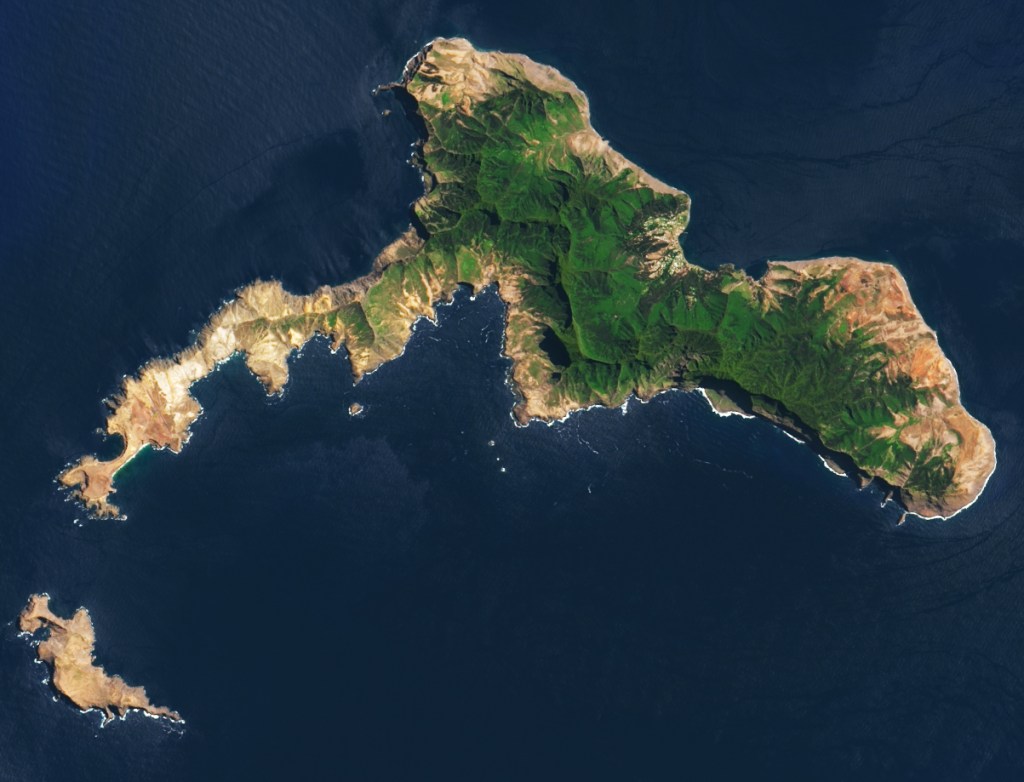
“From 1704 to 1709, the island was home to the marooned Scottish sailor Alexander Selkirk, who at least partially inspired novelist Daniel Defoe‘s fictional Robinson Crusoe in his 1719 novel, although the novel is explicitly set in the Caribbean.” –Wikipedia
Wednesday, May 30.
…We hope soon to fall in with the south-east “trades,” which will waft us to the equator in a short time. The weather is daily becoming milder, which has brought the passengers on deck attired in their summer costumes. Flannel shirts and other woolen clothing have been stowed snugly away for future use.
Yesterday the after-cabin gamblers, not having the fear of Captain Fairfowl’s mandate before their eyes, commenced operations again. The game during the day was “ keno,” not before played on board. The game being new, the green ones bet heavily with the never-failing result—the more they put down the less they took up! Distance sailed, 94 miles.
Thursday, May 31.
…We were not looking for a dead calm in this latitude; but during our pilgrimage in this world of woe, we must take things as they come and thank God they are no worse.
Steerage mess No. 1 furnished the cook with apples for dumplings which were served at dinner, but they were very unsavory in consequence of of having been boiled in salt water.
The blacklegs have been busily at work again today. Toward night they came to grief. One of the boys won $300, which bursted the bank! … Distance sailed, 41 miles.
Friday, June 1… Distance sailed, 24 miles.
Saturday, June 2.
We are still in the “horse latitudes,” and the wind has been blowing a “Paddy’s hurricane” (i.e. dead calm – ed.) during the past twenty-four hours. This is the first month of winter in this latitude, and the weather is as mild and balmy as midsummer in the United States.
As we approach our port of destination, firearms and mining implements increase rapidly in value. Twenty-five dollars has been offered and refused for revolvers that cost $10 in Philadelphia. A gold-washer that cost $6 was sold to-day for $15, and I refused an offer of $3 for a hand-pick that cost me only fifty cents. I am waiting for an advance in the market before I unload… Distance sailed… 23 miles.
Sunday, June 3.
…Our expectations of reaching the equator in fifteen days from Talcahuana have already vanished like a dream. One week has elapsed since we left that port and we have made scarcely one-third of the distance. When the Osceola sailed from Philadelphia, we expected to reach San Francisco in five months at the farthest. That time has nearly expired, and we are still nearly 6,000 miles from the land of promise.
It is now a fixed fact that our voyage will not be completed in less time than six months, with the chances in favor of its being prolonged beyond that time. Verily, the way of the California-bound passenger is hard. Distance sailed, 30 miles.
Monday, June 4… Distance sailed, 70 miles.
Tuesday, June 5.
…This afternoon… the steerage passengers have killed time by firing their rifles and pistols at porter and wine bottles suspended from the yards. Distance sailed, 55 miles.
Wednesday, June 6.
…This morning I witnessed one of the grandest scenes of my life, and one that I shall probably never again behold. I beheld at the same moment the god of day lift his golden head above the waves of the ocean to resume his diurnal course, and the goddess of night, after having performed her wonted task, sink into the embrace of the great deep. It was a scene of great sublimity, and every soul on board gazed upon it with feelings of reverence mingled with admiration… Distance sailed, 49 miles.
Thursday, June 7.
…Last evening the passengers mustered on the quarter-deck for the purpose of having a dance. The “El Dorado Band” played a variety of lively airs, which were accompanied by the “light fantastic toes” of a majority of the passengers.
At nine o’clock, P.M., Captain Fairfowl spread a collation (a light, informal meal – ed.) in the after-cabin, to which all hands were invited. Distance sailed, 82 miles.
Friday, June 8.
…Last night the steerage cook was ordered by the Captain to keep watch, which so exasperated him that he did not turn out this morning at the usual hour to commence his culinary duties. The old skipper called him aft and asked him why he had not kindled a fire in the galley, as usual. He informed the Captain that he would not perform the duties of both cook and sailor—he shipped as cook, and would perform that duty only.
He was ordered by the Captain to go forward and commence operations in the galley at once, but being rather dilatory in his movements, the old skipper seized a rope and commenced plying it briskly over his back and shoulders, at the same time ordering him to go forward, which command he obeyed very reluctantly. In a few moments he was again called aft by the Captain, who ordered the mate to seize him up in the main rigging for punishment. The cook informed the Captain that he was not on board a man-of-war, and would not submit to a flogging.
The old skipper did not wait upon the order of going, but went for the knight of pots and kettles immediately, and for a few moments there was a lively time on board the Osceola, with the following result: Captain knocked down and the cook placed in irons.
At eleven o’clock, A.M., the Captain relented—hunger will tame a crow—released the cook and ordered him to resume his duty, and in future to behave himself like a man. The cook nodded assent, and will not knock the old skipper down again until he makes another attempt to flog him! Distance sailed 94 miles.
Saturday, June 9.
…Our prospects of reaching California by the 20th of next month are now very promising. If we are not becalmed on the “line,” we shall make an average run between Talcahuana and San Francisco…
We are now in the tropics, having crossed Capricorn this forenoon… Distance sailed, 90 miles.
Sunday, June 10. … Distance sailed… 168 miles.
Monday, June 11.
…The “trades” were light at first, but they have gradually increased to a ten-knot breeze, and should they continue ten days, we shall be north of the equator. The weather has been warm and hazy, reminding me of Indian Summer in Pennsylvania.
This afternoon all the cheese on board the brig was served out in equal portions to the passengers, each receiving about two weeks’ allowance. Distance sailed, 161 miles.
Tuesday, June 12. …Distance sailed, 150 miles.
Wednesday, June 13. … Distance sailed, 40 miles.
Thursday, June 14. … Distance sailed, 70 miles.
Friday, June 15. …Distance sailed, 170 miles.
Saturday, June 16.
…If we are fortunate enough to escape a calm on the equator, and are blessed with this wind for thirty consecutive days we shall be at anchor in the harbor of San Francisco… Distance sailed, 191 miles.
Sunday, June 17… Distance sailed, 172 miles.
Monday, June 18.
…All hands, including the cook, are in good humor.
Now that we are on the last quarter of our voyage, the passengers are busily engaged overhauling their tents and mining utensils… Distance sailed, 164 miles.
Tuesday, June 19.
…The weather is gradually becoming warmer—this being the hottest day experienced since we doubled Cape Horn. We shall in all probability soon have occasion to use the awnings and windsails, as the weather must necessarily be hot at this season of the year north of the equator.
This afternoon the Captain opened his heart and ordered a hog killed, a portion of which will be made into a sea-pie tomorrow for the steerage passengers. Distance sailed, 161 miles.
Wednesday, June 20.
…This has been general washday with the passengers. Lines stretched across the deck are loaded with wet clothes, as also are the stays, rigging and spanker-boom. Salt-water soap is just now in great demand among the washermen —some exchanging shaving soap of a superior quality for the same bulk or weight of salt-water soap. One of the passengers, not being overstocked with discretion, offered to sell his traveling-bag for two bars of salt-water soap, but he did not find a purchaser… Distance sailed, 160 miles.
Thursday, June 21.
…Last night several of the passengers “took up their beds and walked” on deck, where they slept until morning, undisturbed by bugs or fleas. This morning I treated myself to a dose of Captain Fairfowl’s famous Canchalagua pills, but what effect they will have remains to be seen. The Captain believes them to be a sovereign balm for all the ills that flesh is heir to. Distance sailed, 172 miles.
Friday, June 22…Distance sailed, 152 miles.
Saturday, June 23… Distance sailed, 140 miles.
Sunday, June 24.
…Now that the weather is growing warmer, the passengers are becoming as rabid as mad dogs. At breakfast, this morning, three altercations occurred—two in the after-cabin and one in the steerage.
The steerage row commenced first, and passed off without any blows being struck. The first quarrel in the cabin resulted similarly; but in the second melee a rough-and-tumble fight ensued, in which a little bad blood was spilled. Distance sailed, 135 miles.
Monday, June 25.
…We are now near the equator, and hope to cross it before daylight tomorrow morning. We are half-way between Talcahuana and San Francisco, with the prospect of reaching the latter place within twenty-five days.
I have been on board the Osceola so long that every plank in her deck looks like an old
acquaintance; yet, as familiar as they appear, I am extremely anxious to bid them farewell forever. Distance sailed, 150 miles.
Tuesday, June 26.
…We crossed the equator at one o’clock this morning, in longitude 115° 40′ west… Distance sailed, 152 miles.
Wednesday, June 27… Distance sailed, 139 miles.
Thursday, June 28.
…The heat was very oppressive, but today we have been fanned by a delightful breeze, which has in a slight degree counteracted the effects of the heat.
Since we left Talcahuana every berth in the brig has been overrun with bed-bugs and fleas, and the past two weeks our sufferings have been intolerable.
Today several of the passengers have been figuring out the date of our arrival in San Francisco. According to their ciphering we shall arrive there on the fifteenth of next month—if figures don’t lie. Distance sailed, 162 miles.
Friday, June 29.
…This is the first squally weather we have encountered the past two weeks, and it has somewhat surprised us, as we did not count on meeting rough weather during the balance of the passage, but we know not what the morrow may bring forth, particularly in these latitudes… We are now in the latitude of Panama. Distance sailed, 179 miles.
Saturday, June 30.
…Captain Fairfowl has been quite unwell all day, and has remained in his berth most of the time. There is a rumor floating about the brig that he has been sampling drugged wine again. We are off Guatemala… Distance sailed… 130 miles.
Sunday, July 1.
Our good luck is failing us. During last night and today the wind has been unfavorable, which has headed us off our course five or six points. The weather has been clear, and the wind bracing and invigorating. The morning and forenoon passed off quietly, but this afternoon the Captain cursed the cabin passengers for insinuating that he had sampled the brandy in the doctor’s medicine-chest.
Liquor is getting scarce and the Captain is convalescing rapidly… Distance sailed… 137 miles.
Monday, July 2.
…The old skipper is on his pins again, and today resumed his accustomed duty… Distance sailed, 97 miles.
Tuesday, July 3.
…Captain Fairfowl opened his heart this afternoon and presented to the steerage messes three turkeys, which will be served up for dinner tomorrow—the glorious Fourth! Distance sailed, 16 miles.
Wednesday, July 4.
Fourth of July and a dead calm in the tropics, with the thermometer at 83° in the shade! This day being the seventy-third anniversary of American independence, all hands concluded to celebrate the event in a becoming manner. Accordingly, at daylight, the ensign, union-jack and pennant were spread to the breeze, a salute of small arms fired… and a committee selected to prepare the regular toasts for the occasion. After the reading of the Declaration of Independence, by Col. James A. Banks, another salute was fired, and the meeting adjourned until three o’clock, P.M.
Having partaken of the best dinner the Osceola could spread, we met at the appointed hour to conclude the festivities of the day. Thirteen regular toasts appropriate to the occasion were read by the president, which were loudly cheered by the assemblage.
The intervals between the toasts were enlivened by appropriate music by the El Dorado band and several patriotic songs by the “O Susannah Serenaders.” The regular sentiments were succeeded by some fifty volunteer toasts, many of which were rich, rare and racy, and called down thunders of applause….
At sundown, when the colors were hauled down, another salute was fired and three hearty cheers given, which aroused the fishes and caused old Neptune to send back the echo; and thus ended the 4th of July, 1849, at sea! Everything passed off quietly and soberly. There was no liquor on board! Distance sailed, 20 miles.
Thursday, July 5.
…Last night I was so terribly annoyed by that lively and ubiquitous little “animile,” the flea, that I was compelled to vacate my bunk and go on deck. The rays of a tropical sun have been concentrated all day on my mattress and blankets, and I have also given the latter a salt-water douche. I hope that the sun and salt-water combined have given the fleas their eternal quietus… Distance sailed… 9 miles.
Friday, July 6.
During last night and today there has not been sufficient wind to fill the sails, consequently they have been flapping listlessly against the masts and rigging. The sky has been unclouded and the weather oppressive… Distance sailed, 12 miles.
Saturday, July 7. … Distance sailed, 47 miles.
Sunday, July 8.
…We are now about 1,300 miles distant from the Golden Gate, with a fair wind that would waft us there in eight days, if the brig were allowed to head the proper course; but our Captain is afflicted with the dumps, and is as obstinate as a mule. He will steer any course in preference to the correct one, which will probably prolong our voyage another month. He informed one of the passengers to-day that we would not reach San Francisco before the 10th of August. A cold, drizzling rain has been falling all day. Distance sailed, 100 miles.
Monday, July 9.
…The wind is gradually hauling around to the eastward, and I should not be surprised if we were to fall in with the north-east “trades” within forty-eight hours. The weather has been clear and pleasant, and the passengers have spent most of the day on deck. We are today off the coast of Mexico. Distance sailed, 110 miles.
Tuesday, July 10.
…Last night the wind hauled around to the south-east, and during the day it has changed to the northeast, from which quarter it is still blowing quite fresh. We have been heading north-west by west all day, and running at the rate of eight knots an hour…
Our last porker was slaughtered today; therefore, we may expect a good dinner tomorrow.
Our last pig is slaughtered/For tomorrow’s sea-stew/And we’ll go for that porker/Like Yankees, true blue! Distance sailed, 139 miles.
Wednesday, July 11.
…The weather is damp and chilly, reminding one more of fall in the United States than midsummer in the tropics. The thermometer this evening is down to 70°, and overcoats are in demand among the passengers… Distance sailed, 172 miles.
Thursday, July 12.
…The Captain regrets not having steered a northerly course at the commencement of this week, when he had the opportunity. Should the present wind continue until we reach the latitude of San Francisco, by steering our present course we shall be some 1,200 miles to the westward of that port. Although directly under the sun, the atmosphere is quite chilly. We are this evening off Cape St. Lucas, the southern-most point of Lower California… Distance sailed, 148 miles.
Friday, July 13.
…The month of October in Philadelphia is more mild and pleasant than have been the past five days in the tropics. This forenoon we crossed the Tropic of Cancer, and if we are permitted to steer our course during the next six days, we shall at the expiration of that time be at anchor in the Bay of San Francisco. Distance sailed, 134 miles.
Saturday, July 14.
…The head-winds which have prevailed during the past week have given all hands the blues, and they move silently about the deck with elongated visages, reminding one very much of a disconsolate widow or a young married man with a strong-minded mother-in-law. Distance sailed, 118 miles.
Sunday, July 15.
Last night the wind veered a little to the northward, and today we have been heading nearly a due west course. The wind has been very light, and all on board are inclined to the belief that it will haul around to the westward very soon or die away entirely… Distance sailed, 126 miles.
Monday, July 16.
We are still wrestling with an adverse wind, and the weather is damp and chilly. We are now in longitude 130° west, and the Captain says he will put the brig on another tack tomorrow and run direct for the Golden Gate.
A box of clothing belonging to one of the passengers, stowed in the hold since we left Rio, was opened to-day and its contents found to be very much injured by mould and mildew. Distance sailed, 88 miles.
Tuesday, July 17.
Last night the wind hauled around to the northward and eastward, and since that time we have been heading north-west, but in consequence of being so close on the wind we have made very little progress. The wind is dead ahead, and so good-bye, San Francisco, until it changes. The sun has been obscured by clouds nearly all day, and the weather continues chilly and disagreeable.
Provisions are getting scarce—some articles being entirely exhausted. The hold was broken out today for pork, but not a single barrel could be found. The sugar and cheese are also among the things that were but are not, and the water is nearly all gone. The truth of the matter is, we are in one of those predicaments sometimes narrated but not often experienced. Distance sailed, 87 miles.
Wednesday, July 18.
…If the wind continues in the north-east during the next eight days, we shall be compelled to run as far westward as 140° before we tack the brig and run for our port of destination.
The weather this forenoon was quite winter-ish. At meridian the clouds that have shrouded the sky the past week broke away, and the sun shone brightly for about two hours. The latter part of the day has been squally, with occasional showers. The crew has been employed today painting the brig. Distance sailed, 84 miles.
Thursday, July 19.
…The weather has been cloudy, damp and chilly, and all hands have the dumps. How long we shall be knocked about by adverse winds, is one of those things that no “feller” can find out. At meridian San Francisco bore north-east by north, distant 800 miles.
The crew has been reeving new signal-halyards, repairing the side-ladders, and doing other odd jobs, in order to get the brig “ship-shape” before reaching port. Distance sailed, 112 miles.
Friday, July 20.
… I have now come to the conclusion that we are booked for a passage of two hundred days!
This morning Captain Fairfowl ordered his first officer below. This is the fifth officer the old skipper has put off duty since we sailed from Philadelphia. Should he ever be fortunate enough to obtain command of another vessel, I would advise him to ship at least a gross of mates. He would find use for all of them before the expiration of a voyage of ninety days. Distance sailed, 100 miles.
Saturday, July 21.
…We shall probably be in the latitude of San Francisco on Wednesday next. The Captain will then tack the brig and stand to the eastward, wind permitting.
Last night the moon dispersed the clouds, and today the atmosphere has been clear and the weather cool… Distance sailed, 108 miles.
Sunday, July 22.
…The sun has been obscured by clouds nearly all day, which has rendered the atmosphere chilly. We are now in the same latitude as San Luis Obispo, Upper California, and at meridian tomorrow we shall probably be off Monterey… Distance sailed, 122 miles.
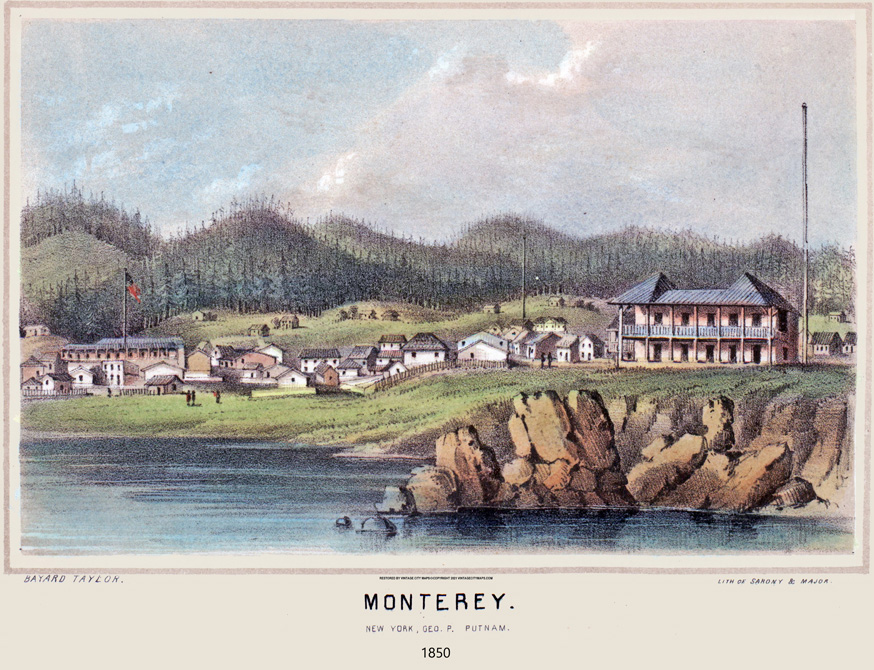
Monday, July 23.
…The weather has been warmer than on any previous day the past two weeks. I availed myself of the sunshine, and washed and dried sundry shirts and towels.
Several turtles have been seen floating on the surface of the water at no great distance from the brig… Distance sailed, 72 miles.
Tuesday, July 24.
…The entire day has been a succession of variable breezes and calms. This morning at eight o’clock the brig was put about three times in about the time it requires to record the fact, and on the last tack she headed her course twenty minutes.
We find that we have only twenty-five days’ water on board, which causes things to look rather squally. We are now on an allowance of two quarts of water per day, which allows us only one pint each for drinking, and if we do not soon get a fair wind this quantity will be reduced one-half. Distance sailed, 18 miles.
Wednesday, July 25.
…Early this morning the wind commenced hauling to the southward, and at this time, eight o’clock, A.M., it is blowing from the south-west. Although the wind has been light, by the aid of studding-sails we have managed to make about three knots an hour.
Captain Fairfowl is of the opinion that the present wind will waft us into port. God grant that it may, for our water and provisions are getting very scarce, and much suffering will occur should the voyage be prolonged another month. Distance sailed, 42 miles.
Thursday, July 26.
The wind increased gradually last night, and up to four o’clock this afternoon we have been heading our course at the rate of six knots an hour with studding-sails set below and aloft…
This forenoon the cabin cook and steward had a rough-and-tumble fight about their relative positions, in which both parties were severely pummeled. The cook gave the steward a whack on his cabasa with the potato-masher, and the latter returned the compliment with his fists so effectually that in a few moments the cook’s figure-head was sadly disfigured—it is doubtful whether his mother would recognize him. Distance sailed, 70 miles.
Friday, July 27.
…Yesterday all hands were very much elated with the prospect of reaching San Francisco in the course of four of five days, but the sudden change in wind and weather today has saddened their hearts, and they look as crest-fallen as disappointed politicians. We are on an allowance of three pints of water each. Distance sailed, 142 miles.
Saturday, July 28.
…A fair wind would carry us into our port of destination in three days, but the wind in these latitudes is so fickle that very little reliance can be placed upon it. This afternoon a general search was made in the hold for water, and, to our great joy, we find that there are thirteen casks on board, being thirty days’ allowance at the rate of two quarts for each person. Distance sailed, 87 miles.
Sunday, July 29.
…Owing to the favorable wind the Captain has added a pint of water to our daily allowance… Distance sailed… 86 miles.
Monday, July 30.
…Our hearts were gladdened this forenoon by the appearance of the sun for the first time in two days. Toward the close of the afternoon the weather became thick and foggy… At meridian today, San Francisco bore due east, distant 383 miles. Distance sailed, 87 miles.
Tuesday, July 31.
…The past two days, large quantities of drift-wood, sea-weed and kelp have floated past us—strong indications that land is not far distant. A great change in the color of the water has also been apparent within the past thirty hours; and this evening wild geese and a species of duck that does not venture far from land, flew past us. Distance sailed, 160 miles.
Wednesday, August 1.
…This afternoon the wind has been light and baffling, and a heavy ground-swell has kept the brig rolling about like a saw-log in a millpond.
During the day we have been enveloped by a dense fog which has prevented us from seeing half a mile in any direction. The anchors were got over the bow ready to be let go should occasion require. Land-birds have been hovering about the brig all day. Distance sailed, 30 miles.
Thursday, Aug. 2.
Light and baffling winds, a dense fog and damp and chilly weather all day. At sundown the fog partially lifted, which enabled us to get a glimpse of the “land of promise,” directly ahead and distant about 10 miles.
Later in the evening, the fog disappeared, and we could define the bold outlines of the coast for many miles. The Captain says we are some 15 miles to the northward of the harbor of San Francisco, therefore we shall lay off and on during the night and run into port tomorrow, wind permitting… Distance sailed… 60 miles.
Friday, Aug. 3.
…The Captain took an observation at noon and found that we were 22 miles to the northward of the port of San Francisco. This afternoon we have been running slowly down the coast. Several of the passengers are so anxious to get on shore that they have been ahead in one of the boats nearly all the afternoon towing the brig…
The fog the past week has been so dense that the sun has been obscured most of the time. During the day whales, porpoises, puffing-pigs, sea-lions, seals and sharks have been seen in all directions. Distance sailed, 50 miles.
Saturday, Aug. 4.
…This forenoon the water has been as smooth as a mirror, but the fog is so dense that we cannot see twice the length of the brig…
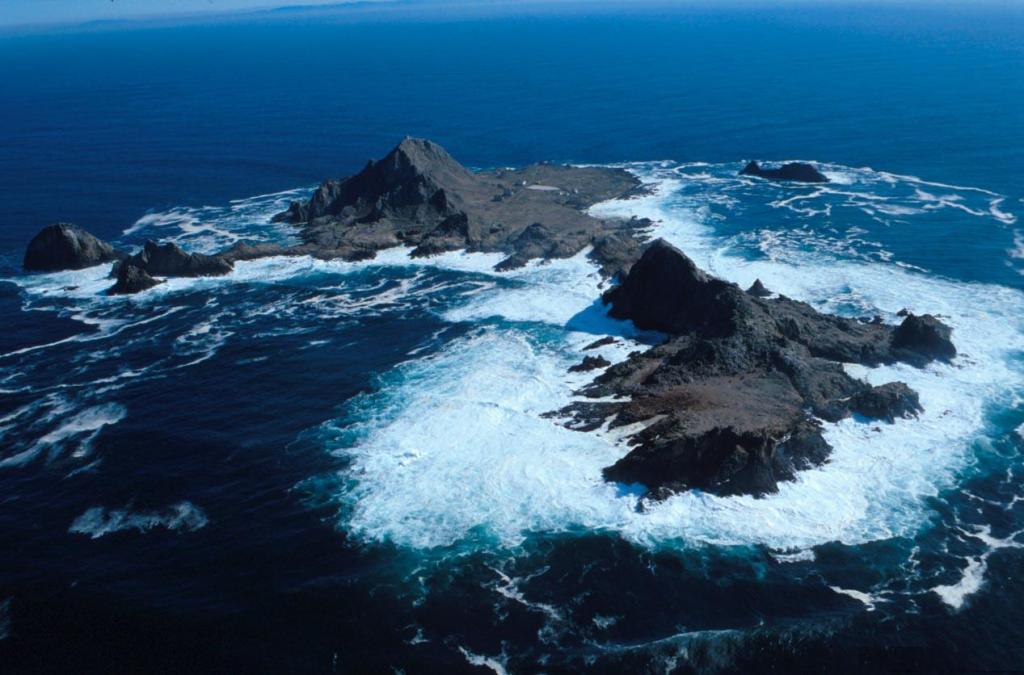
At five o’clock, P.M., we made the Farallone Islands, bearing south by east, distant some 3 miles. The Farallones are a mass of barren rocks, projecting several hundred feet above the surface of the water, and are inhabited only by sea-fowl, sealions and seals. They bear west by south from San Francisco, and are about 25 miles distant from that port.
At half-past five o’clock a four-knot breeze sprang up, and at this writing, eight o’clock, P.M., we are within l2 miles of the Golden Gate. We shall anchor tonight off the mouth of the harbor and run in tomorrow morning, wind permitting. Distance sailed, 31 miles.
Sunday, Aug. 5.
Last night we came to anchor just outside the Golden Gate, in eighteen fathoms
of water, where we remained until six o’clock this morning, when we stood into the harbor, and at eleven o’clock, A.M., rounded Clark’s Point and dropped anchor off the town of San Francisco.
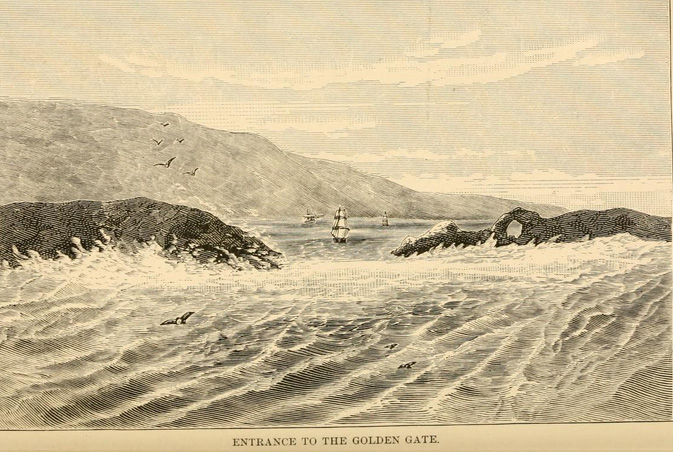
The cable had scarcely ceased rattling over the bitts*, before half a dozen shore-boats, manned by piratical-looking beach-combers, were alongside of us, which were soon filled with passengers at $2 per head. Not being overstocked with the one thing needful, I concluded to await a passage ashore in one of the brig’s boats, which the Captain informed me would be ready in a few hours.
The bitts are the wooden frame the anchor cable moves through when dropped.
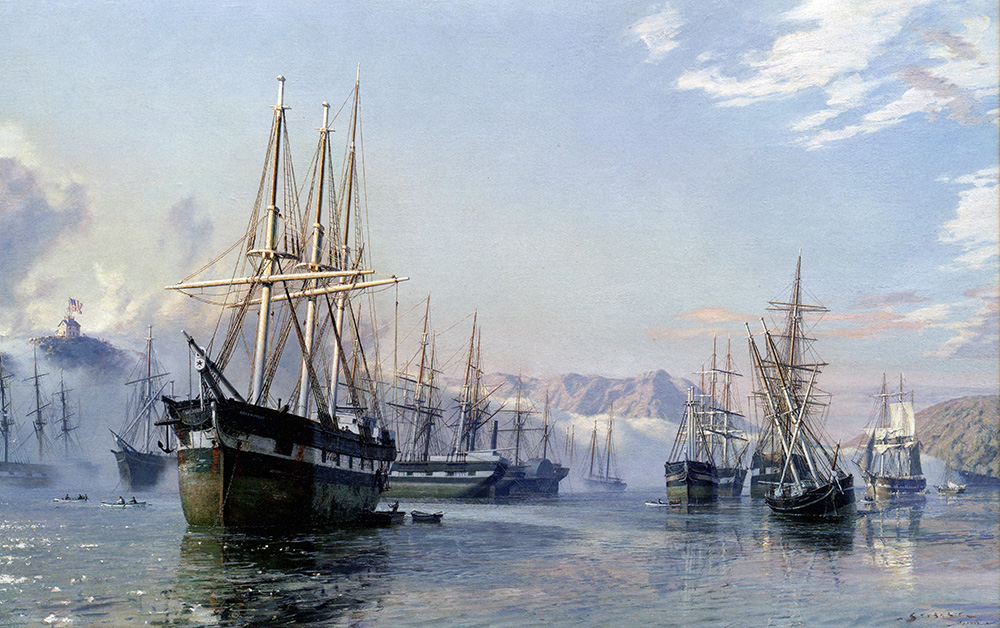
Immediately after dinner the boat was got ready, and I went ashore for letters, but on reaching the post-office I found it closed, which caused me to turn away with a sad heart. I soon returned on board the brig and commenced arranging my baggage preparatory to transferring it on shore.
Total number of days at sea, 176, in port, 25.
Total number of miles sailed between Philadelphia and San Francisco, 19,308.
At daylight on the morning of the 6th, I went ashore in the market-boat and again wended my way over the sand-hills to the post-office, where I found some two hundred individuals already formed in file at the delivery-window anxiously awaiting the opening of the office. I filed in at the rear of the line formed at the window; at seven o’clock, A.M., the shutters were unbarred and thrown open, and the delivery of mail-matter commenced.
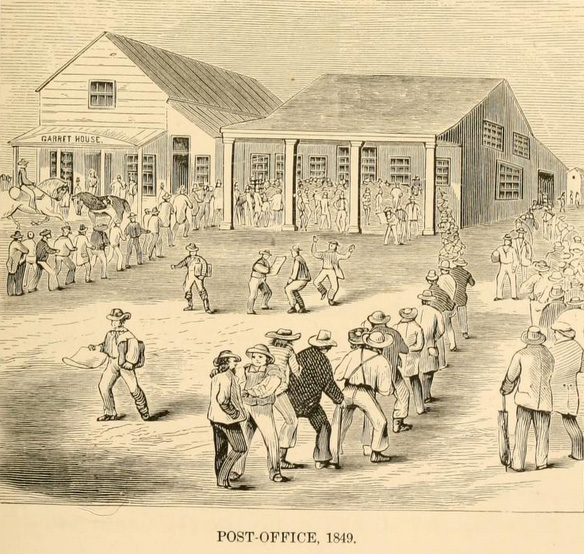
After remaining in the line upwards of two hours, I reached the window and received three letters and a New York Herald, containing my letter written for that paper at Rio. I clutched the letters with a nervous hand and with fear and trembling broke the seals and glanced hurriedly over their contents. They contained intelligence from the States up to the month of June, and, when I learned that the loved ones in their far-away home were all well, my heart leaped with joy. On my way down to the Plaza I met several of my fellow-passengers on their way to the post-office. When I informed them that it would require half a day to reach the delivery-window, a disconsolate Dutchman, from one of the interior counties of Pennsylvania, ejaculated, “Mine Got in himmel; vat a tyfel* of a country dis ish!” I consoled him with the idea that the farther he went, the worse he would probably fare.
*Teuffel – German for devil
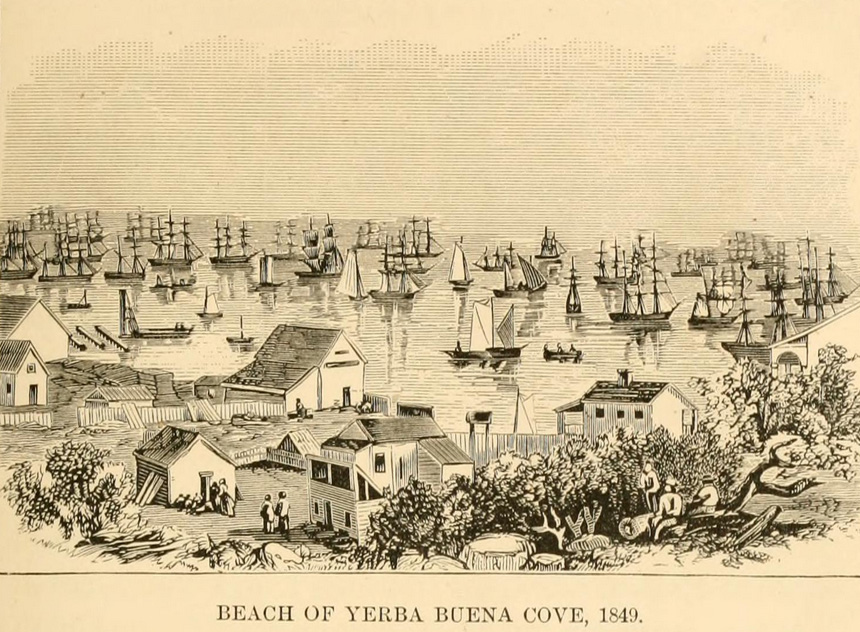
San Francisco—formerly Yerba Buena—is a queer place. It contains at this time a dozen adobe structures and perhaps two hundred roughly-constructed frame buildings, mostly shipped around Cape Horn. The beach, Happy Valley, for the space of two miles, is covered with canvas and rubber tents, and the adjacent sand-hills are dotted to their summits with these frail but convenient tenements of the prospective miner. The population, numbering perhaps five thousand, is as heterogeneous as their habitations.
It seems as though every nation on the face of the earth had sent a representative to this place, and that they had all arrived with their credentials. Such a medley of languages and jargon of tongues the world has seldom seen. It is a modern Babel. Yet, paradoxical as it may seem, it is nevertheless true, that life and property are as secure here as in the cities of New York, Boston or Philadelphia, and fire-arms are seldom carried as weapons of defense by either citizens or strangers.
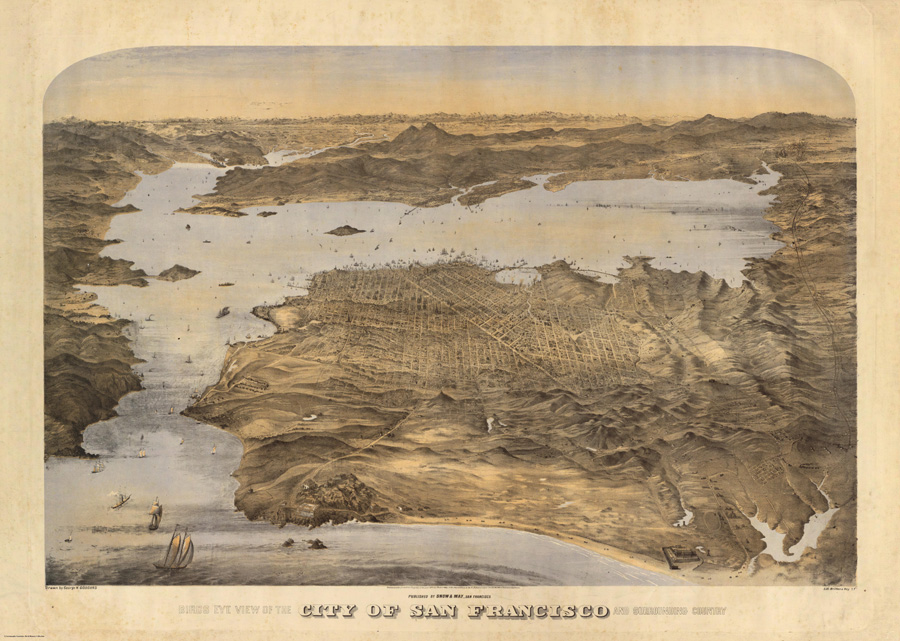
John E. Smith:
In California I shipped on the steamboat McKinnon, carrying freight and passengers from San Francisco to Sacramento.
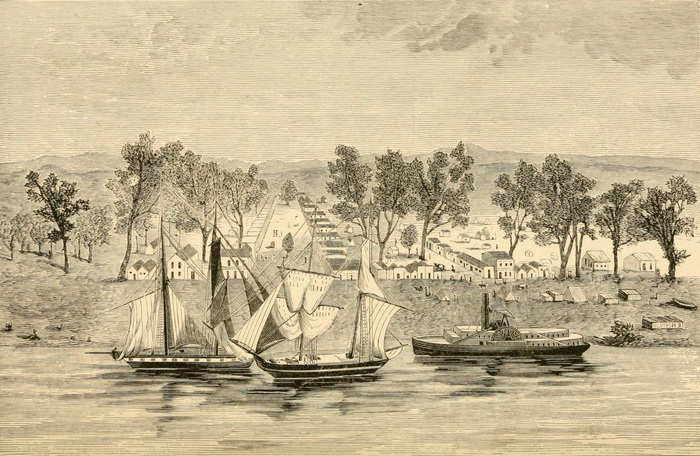
The steamer must have been the SS McKim, rather than the McKinnon, as there is no record of the latter, although the former is often found logged under variations like “McKimmons” or “McKinney” in the chaotic mix of transports during the gold rush. The nearly 400-ton vessel was one of the first ships that regularly traveled the route Smith described, carrying freight and passengers between San Francisco and Sacramento during the peak of the Gold Rush in 1849.
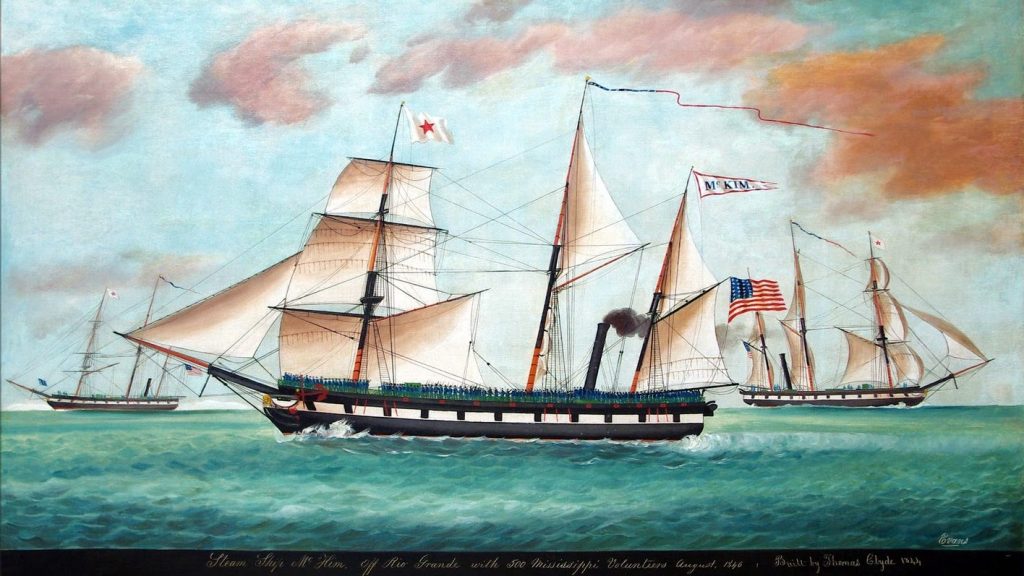
News of the discovery of gold, confirmed by President Polk in December 1848, sparked an unprecedented demand for transportation to the West Coast. The McKim, being a sturdy, ocean-capable screw steamer, was acquired by interests looking to capitalize on the California trade. In the spring it left New Orleans for the West Coast, steaming into San Francisco Bay in mid-August.
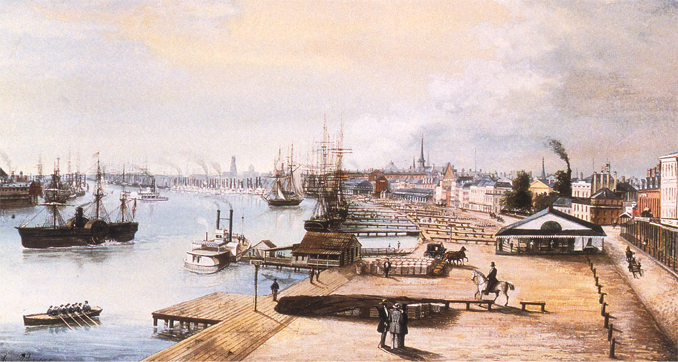
Upon arrival the McKim was quickly pressed into service on the trip to the new Gold Rush epicenter. At this time the short river run was incredibly profitable, and the McKim was the first vessel to arrive to take advantage of the demand. The initial advertised rates in October 1849 show deck passage was $20 and cabin passage was $30, roughly equivalent to $700 & $1000 in today’s currency. After more ships arrived and competition became fierce, tickets dropped down to $1 or so, more like $35 today.
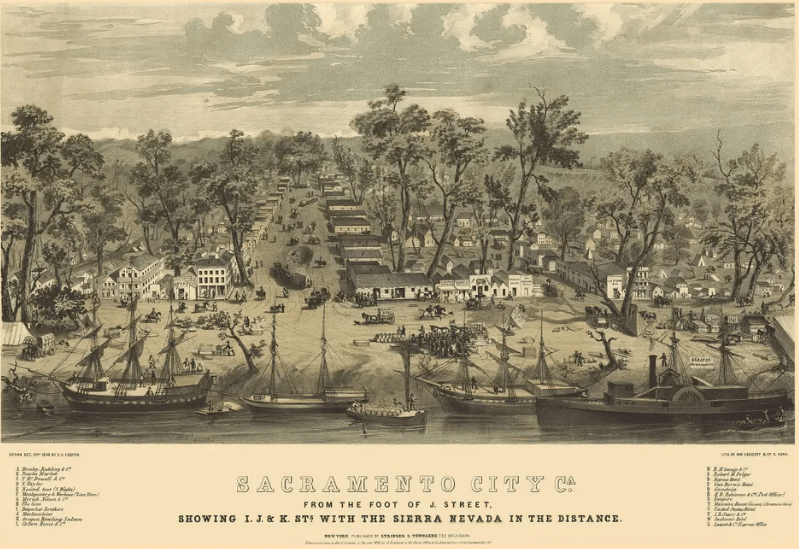
Next time: teenage Johnnie Smith gets in on the gold rush fever!

 Brian Hildebrand Land
Leave a comment